


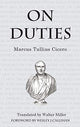
On Duties by Marcus Tullius Cicero
ON DUTIES deserves more attention than it gets, and it rewards the attention it receives, because it deals with the question of the well-lived life in a clear, thoughtful, accessible, and compelling manner. Cicero believed>On Duties to be his magnum opus, and much of history has agreed with him on this. Of On Duties, the French philosopher Voltaire wrote: No one will ever write anything more wise, more true, or more useful. And Martin Luther, in his Table Talk says this of Cicero: Let those who wish to see a true philosophy read Cicero. Cicero was a wise and industrious man, and he suffered much and accomplished much.
On Duties>was the second book to be printed by Gutenberg's press. Parts of it served as inspiration for Dante Alighieri's>Divine Comedy. St. Ambrose was so enamored with the work that he wrote his>On the Duties of the Clergy with Cicero's On Duties as the model, and refers to it throughout his own book.
The three books that make up>On Duties>are full of historical examples which are worth their weight in gold. They, like Homeric similes, are marvelous windows into an age that is not described in any ancient texts since the audience of the texts are written to people who shared the age and therefore needed no descriptions. But they also give us Cicero's own culturally conservative interpretations of the events of his time, and this is very valuable indeed.
| SKU | Unavailable |
| ISBN 13 | |
| ISBN 10 | |
| Title | On Duties |
| Author | Marcus Tullius Cicero |
| Series | |
| Condition | Unavailable |
| Binding Type | |
| Publisher | |
| Year published | |
| Number of pages | |
| Cover note | Book picture is for illustrative purposes only, actual binding, cover or edition may vary. |
| Note | Unavailable |
View All Editions
Applied Filters (0)
Sort by:
Loading editions...