


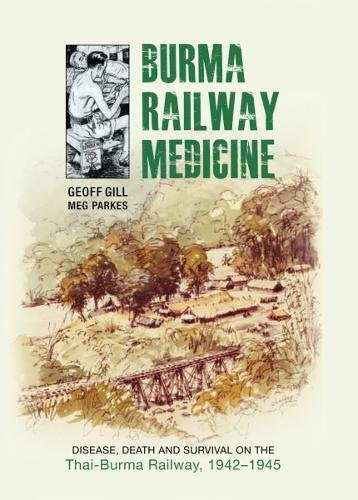
Burma Railway Medicine by Geoff Gill
The 'Death Railway' was very well named. More correctly called the Burma or Thai-Burma Railway, it was a major project during Allied Far East imprisonment under the Japanese. Over 60,000 prisoners worked on its construction, the majority of whom were British, and some 20 per cent died before release in 1945. Working conditions were appalling, the climate inhospitable, and food supplies grossly inadequate, making the POWs terribly vulnerable to a plethora of tropical infections and syndromes of malnutrition. No medical care was given by their Japanese captors, and it fell to the Allied POW doctors and medical orderlies to treat the sick, which they did with little in the way of medical equipment or drugs. However, with remarkable ingenuity and inventiveness they dealt with recurrent attacks of malaria and dysentery, as well as tropical ulcers and beriberi, and devastating epidemics of cholera. Their efforts undoubtedly saved hundreds of lives. This revealing book presents for the first time an in-depth analysis of the medical crisis in the Allied prisoner of war (POW) camps on the Thai-Burma Railway, between 1942 and 1945.While it is written mainly from a British perspective, the authors acknowledge the contributions made by the many different nationalities of medical staff working together. Burma Railway Medicine is the result of a long post-war collaboration between the Liverpool School of Tropical Medicine (LSTM) and British ex-Far East POWs. Professor Geoff Gill led research which encompassed both the physical and psychological aftermath of these men's experiences. In more recent years the LSTM Far East POW Project has moved to medical historical enquiries into the POW experience, including a major oral history project led by co-author Meg Parkes. Part of this work is included in this book as voices from the railway. The aim of Burma Railway Medicine is to critically recount remarkable events which deserve recording and understanding. It is an historical work that makes the detail of the medical battle to survive accessible to everyone, be they lay, healthcare or academic readers, and it has real relevance to medicine today, as well as to society in general.
Geoff Gill, MA, MSc, MD, PhD, FRCP, DTM&H, is Emeritus Professor of International Medicine, Liverpool School of Tropical Medicine and a Consultant Physician at Aintree University Hospital, Liverpool. He began seeing former Far East POWs referred to the Tropical School in the 1970s, and has maintained a close interest in their health and history since. Geoff led the long collaboration between the School and the UK Far East POWs community, and helped define many of their long term health problems - in particular chronic worm infestations, nutritional nerve damage and post-traumatic stress disorder (PTSD). More recently, he has been involved with historical enquiries, notably concerning disease patterns and medical management on the Thai-Burma Railway. Meg Parkes, MPhil, is Honorary Research Fellow, Liverpool School of Tropical Medicine, and the daughter of a Far East POW. She trained as a State Registered Nurse in the early 1970s. In 2002 and 2003 Meg published her father's diaries, which indirectly led to her being asked to do an oral history study interviewing Far East POW veterans (FEPOW) for the Liverpool School of Tropical Medicine in 2007. The study became the basis for an MPhil for which she also undertook research into ingenuity and inventive medicine in captivity. A two year Heritage Lottery Fund project followed, introducing Far East POW history into the secondary school curriculum. Awarded her MPhil in 2013, Meg has since researched the unseen documentary art of Far East captivity. An exhibition is planned for 2020, in Liverpool (see website for details). www.captivememories.org.uk
| SKU | Unavailable |
| ISBN 13 | 9781910837092 |
| ISBN 10 | 1910837091 |
| Title | Burma Railway Medicine |
| Author | Geoff Gill |
| Condition | Unavailable |
| Binding Type | Paperback |
| Publisher | Carnegie Publishing Ltd |
| Year published | 2017-05-09 |
| Number of pages | 272 |
| Cover note | Book picture is for illustrative purposes only, actual binding, cover or edition may vary. |
| Note | Unavailable |