


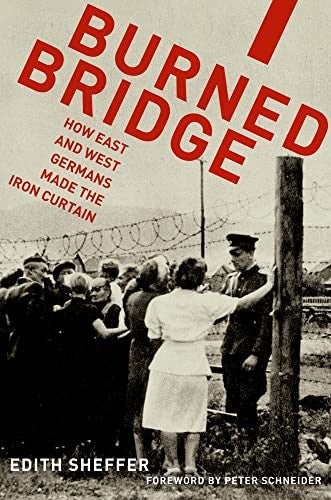
Burned Bridge by Edith Sheffer
The building of the Berlin Wall in 1961 shocked the world. Ever since, the image of this impenetrable barrier between East and West, imposed by communism, has been a central symbol of the Cold War. Based on vast research in untapped archival, oral, and private sources, Burned Bridge reveals the hidden origins of the Iron Curtain, presenting it in a startling new light. Historian Edith Sheffer's unprecedented, in-depth account focuses on Burned Bridge - the intersection between two sister cities, Sonneberg and Neustadt bei Coburg, Germany's largest divided population outside Berlin. Sheffer demonstrates that as Soviet and American forces occupied each city after the Second World War, townspeople who historically had much in common quickly formed opposing interests and identities. The border walled off irreconcilable realities: the differences of freedom and captivity, rich and poor, peace and bloodshed, and past and present. Sheffer describes how smuggling, kidnapping, rape, and killing in the early postwar years led citizens to demand greater border control on both sides - long before East Germany fortified its 1,393 kilometer border with West Germany. It was in fact the American military that built the first barriers at Burned Bridge, which preceded East Germany's borderland crackdown by many years. Indeed, Sheffer shows that the physical border between East and West was not simply imposed by Cold War superpowers, but was in some part an improvised outgrowth of an anxious postwar society. Ultimately, a wall of the mind shaped the wall on the ground. East and West Germans became part of, and helped perpetuate, the barriers that divided them. From the end of World War II through two decades of reunification, Sheffer traces divisions at Burned Bridge with sharp insight and compassion, presenting a stunning portrait of the Cold War on a human scale.
"Sheffer's meticulous research into local and federal German archives, interviews, the press, and questionnaires exposes at a micro-level how power was exerted diffusely in Germany's Cold War regimesThe book suggests that through daily actions borders can become instruments of demographic control, both violently coercive and encouraging complicity from average citizens."--American Historical Review "Sheffer's meticulous reconstruction of life on the German-German frontier sheds welcome light on broader questions of German history, and on the way human communities create and recreate themselves." --Times Higher Education Supplement "An accessible, intriguing academic study tracking the building of the "wall in the head" between East and West Germany long before the actual construction in 1961." -Kirkus Reviews "The Cold War may have been triggered by the great powers, but Edith Sheffer shows that it was also given shape and reinforced by ordinary people who confronted its political realities every day. Her sensitive biography of a divided German community, ranging across the entire Cold War through reunification, is filled with arresting detail, fresh evidence, and surprises. This book helps us understand not just the trauma of the Cold War but also the many troubles Germans have faced in knitting their fractured nation together after the fall of the Wall in 1989. An outstanding and innovative work." --William I. Hitchcock, University of Virginia "Edith Sheffer's exquisitely nuanced and deeply researched narrative rewrites the history of the division of Germany, revealing an East/West border marked by the infamous Wall but actually constructed over time by postwar violence, Cold War tensions, and above all by the local everyday actions and attitudes of ordinary Germans living with and in both sides of the border."--Atina Grossmann, author of Jews, Germans, and Allies: Close Encounters in Occupied Germany "This fascinating micro-history of living with the Iron Curtain traces its divisive social and political impact. Based on exhaustive research, the book explores the local complicity in the construction, maintenance, and subversion of the barrier, illuminates the human dimension of the German division, and explains its lingering post-unification effects."-Konrad Jarausch, author of After Hitler: Recivilizing Germans, 1945-1995 "Edith Sheffer provides fascinating glimpses of the ways in which the Wall between East and West Germany was constructed-in every sense-by Germans on the ground, and in turn affected the character of life on either side. Significations of difference, emotional ties, misapprehensions, and mutual hostilities, were a living reality, changing over time and persisting in new ways long after the Wall itself has disappeared." -Mary Fulbrook, author of Dissonant Lives: Generations and Violence through the German Dictatorships "Edith Sheffer powerfully contributes to dismantling established views on the Cold War. Locals had a constant role in producing the border and, in a bitter irony, neither efforts to evade nor ways of considering the border 'normal' overcame the sense of estrangement among former neighbors." -Alf Lüdtke, University of Erfurt "Lucidly written with plenty of anecdotes...will interest serious history buffs." -Publishers Weekly "Highly recommended." --Choice Magazine
Edith Sheffer is Assistant Professor of History at Stanford University.
| SKU | Unavailable |
| ISBN 13 | 9780199737048 |
| ISBN 10 | 0199737045 |
| Title | Burned Bridge |
| Author | Edith Sheffer |
| Condition | Unavailable |
| Binding Type | Hardback |
| Publisher | Oxford University Press |
| Year published | 2011-11-24 |
| Number of pages | 384 |
| Cover note | Book picture is for illustrative purposes only, actual binding, cover or edition may vary. |
| Note | Unavailable |