


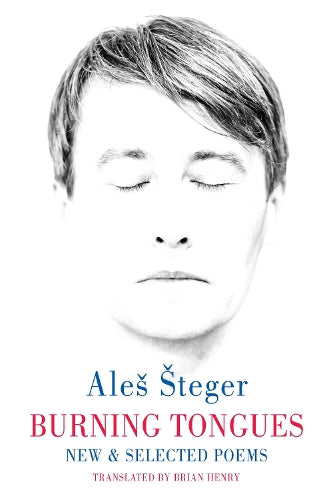
Burning Tongues by Unknown Author
Notable for its moral engagement, Ales Stegers poetry is acutely precise in its observation and concentration. Multi-layered and technically versatile, ingenious and inventive, his poetry is adventurous and playful yet serious in intention, and incessantly curious in its investigations. He loves to ambush the reader with the unexpected.
Aleš Šteger is a poet of the mutable world, “emptied of solidity”, writing “between/ The time of the word/ And the time/ When/ A word/Is devoured”Emerging in the aftermath of the wars that broke former Yugoslavia into many countries, Šteger has become one of the most significant European poets of the new century. In his hands it is as if poetry were giving up its last secrets, “when books don’t open to speak but to whisper”, and metaphors are “instantly dispersed by a galactic wind". His language slips through fissures of time and space, where, for example, “Hayden plays his saxophone in the Hotel Europa Regina” and all manner of ordinary things become objects of cosmic wonderment: bread and knives, shoes, seahorses, toothpicks, earrings and paperclips. We are fortunate to have these selections from five of his books and also new poems, translated beautifully by Brian Henry. More than a new Selected, this is a gift to the English language and a bridge between worlds. -- Carolyn Forché
And what if, just as you open one of those rare, thrilling books in which a terrific foreign poet is carried into English by a terrific poet-translator, the poets tell you, “You have five minutes / Until I turn out the lights.” Better get going, reader. In this long-awaited Selected Poems, Aleš Šteger imagines the poet (which is to say, you, everyone) as a figure of disappearance, slipping through cracks, stepping through two doors at once, turning into quotation, becoming a word, vanishing into a wood, finding a world in which objects – a walnut, an egg, shoes – are awake and looking back, drawing, maybe dragging the poet into a drama that we suddenly see has always been shared. Just so, in a Šteger poem, a piece of meat stuck between the teeth can be linked to revolution and “Whoever thinks hope misses it.” Although Šteger’s poems have that lightness about them that Italo Calvino so admired, they can be, you’ll soon see, devastating. Šteger’s work has earned a huge international audience so that while you’ve been reading this little paragraph, this book has gone into yet another edition. -- Forrest Gander
Aleš Šteger is the real thing! He is the poet of inimitable gifts! He is one of the best Eastern European poets of his generation! It is the truth: Šteger is a marvelous voice, one that takes some of the playfulness of his Yugoslavian compatriots Vasko Popa and Tomaž Šalamun to the whole new level. What is that level? It’s Šteger’s very own kind of wisdom: "Between truth and man / I choose waiting.” What is the source of this wisdom? “I got stuck in silence,” the poet says, “therefore I write.” To which one might add: he knows loss, therefore his poems are beautiful. In these remarkable translations by Brian Henry we are lucky enough to behold in English the work of this major Slovenian voice. -- Ilya Kaminsky
And what if, just as you open one of those rare, thrilling books in which a terrific foreign poet is carried into English by a terrific poet-translator, the poets tell you, “You have five minutes / Until I turn out the lights.” Better get going, reader. In this long-awaited Selected Poems, Aleš Šteger imagines the poet (which is to say, you, everyone) as a figure of disappearance, slipping through cracks, stepping through two doors at once, turning into quotation, becoming a word, vanishing into a wood, finding a world in which objects – a walnut, an egg, shoes – are awake and looking back, drawing, maybe dragging the poet into a drama that we suddenly see has always been shared. Just so, in a Šteger poem, a piece of meat stuck between the teeth can be linked to revolution and “Whoever thinks hope misses it.” Although Šteger’s poems have that lightness about them that Italo Calvino so admired, they can be, you’ll soon see, devastating. Šteger’s work has earned a huge international audience so that while you’ve been reading this little paragraph, this book has gone into yet another edition. -- Forrest Gander
Aleš Šteger is the real thing! He is the poet of inimitable gifts! He is one of the best Eastern European poets of his generation! It is the truth: Šteger is a marvelous voice, one that takes some of the playfulness of his Yugoslavian compatriots Vasko Popa and Tomaž Šalamun to the whole new level. What is that level? It’s Šteger’s very own kind of wisdom: "Between truth and man / I choose waiting.” What is the source of this wisdom? “I got stuck in silence,” the poet says, “therefore I write.” To which one might add: he knows loss, therefore his poems are beautiful. In these remarkable translations by Brian Henry we are lucky enough to behold in English the work of this major Slovenian voice. -- Ilya Kaminsky
Aleš Šteger was born in 1973 in Ptuj, Slovenia, where he grew up, then part of the former Yugoslavia ruled by Tito, which gained its independence when he was 18. He published his first collection at the age of 22, Chessboard of Hours, in 1995, and was immediately recognised as a key voice in the new generation of post-Communist poets not only in Slovenia but throughout central Europe. He has published nine books of poetry, three novels and two books of essays. A Chevalier des Artes et Lettres in France and a member of the Berlin Academy of Arts, he received the 1998 Veronika Prize for the best Slovenian poetry book, the 1999 Petrarch Prize for young European authors, the 2007 Rožanc Award for the best Slovenian book of essays, the 2016 International Bienek Prize and the 2022 International Spycher Prize. His work has been translated into over 15 languages, including Chinese, German, Czech, Croatian, Hungarian, and Spanish. Six of his books have been published in English: The Book of Things (BOA Editions, US, 2010), which won the 2011 Best Translated Book Award and the 2011 Best Literary Translation into English Award from AATSEEL; the collection of lyric essays, Berlin; (Counterpath, 2015); the book of prose poems, Essential Baggage (Equipage, 2016); the novel Absolution (Istros Books, 2017); Above the Sky Beneath the Earth (White Pine Press, US, 2019); and The Book of Bodies (White Pine Press, US, 2022). His retrospective, Burning Tongues: New & Selected Poems is published by Bloodaxe Books in the UK in 2022. He also has worked in the field of visual arts (most recently with a large scale installation at the International Kochi-Muziris Biennale in India), completed several collaborations with musicians and composers including Jure Tori and Vito Žuraj, and collaborated with Peter Zach on the film Beyond Boundaries.
| SKU | Unavailable |
| ISBN 13 | 9781780376257 |
| ISBN 10 | 1780376251 |
| Title | Burning Tongues |
| Author | Ale Teger |
| Condition | Unavailable |
| Binding Type | Paperback |
| Publisher | Bloodaxe Books Ltd |
| Year published | 2022-11-14 |
| Number of pages | 224 |
| Cover note | Book picture is for illustrative purposes only, actual binding, cover or edition may vary. |
| Note | Unavailable |