


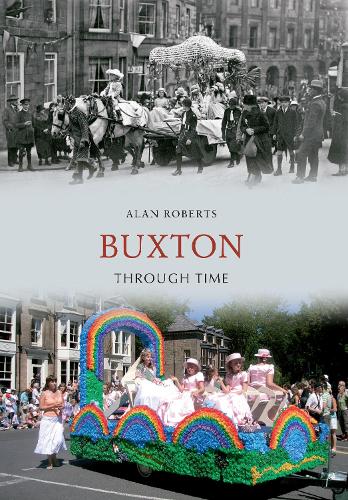
Buxton Through Time by Alan Roberts
Buxton's growth as an inland spa town began in the 1780s when The Crescent was built for the Duke of Devonshire. This was followed by the natural baths, thermal baths, pump room and several large hydropathic establishments. Buxton became a fashionable spa resort, its popularity later boosted by the arrival of the railways. Large villas and hotels were built, as well as a range of entertainment facilities including the Pavilion Gardens and Opera House, to cater for the town's many visitors. By contrast, Buxton is also considered the gateway to the Peak district. The town's position, high up in the hills and at the head of the Wye valley, gives easy access to miles of stunning scenery. Using a fascinating collection of old and new photographs Buxton Through Time sets out to illustrate these many remarkable features and how they have adapted to the passage of time.
Alan Roberts came to the Peak District to work as a research scientist at what was then the Safety in Mines Research Establishment. At his retirement, he was Chief Executive of the Health and Safety Laboratory, as the expanded laboratory had now become. Alan's interests in walking in the Peak District generally, coupled with his interests in research, led him to write three books on landscape history in the Buxton area.
| SKU | Unavailable |
| ISBN 13 | 9781445608174 |
| ISBN 10 | 1445608170 |
| Title | Buxton Through Time |
| Author | Alan Roberts |
| Series | Through Time |
| Condition | Unavailable |
| Binding Type | Paperback |
| Publisher | Amberley Publishing |
| Year published | 2012-04-15 |
| Number of pages | 96 |
| Cover note | Book picture is for illustrative purposes only, actual binding, cover or edition may vary. |
| Note | Unavailable |