
The Cambridge Handbook of Situated Cognition


Summary
The feel-good place to buy books
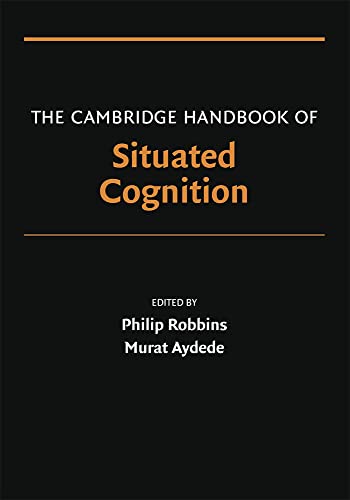
The Cambridge Handbook of Situated Cognition by Philip Robbins
Since its inception some fifty years ago, cognitive science has seen a number of sea changes. Perhaps the best known is the development of connectionist models of cognition as an alternative to classical, symbol-based approaches. A more recent - and increasingly influential - trend is that of dynamical-systems-based, ecologically oriented models of the mind. Researchers suggest that a full understanding of the mind will require systematic study of the dynamics of interaction between mind, body, and world. Some argue that this new orientation calls for a revolutionary new metaphysics of mind, according to which mental states and processes, and even persons, literally extend into the environment. This book is a guide to this movement in cognitive science. Each chapter tackles either a specific area of empirical research or specific sector of the conceptual foundation underlying this research.
“Situated cognition has become a hot topic in cognitive science, encompassing a broad range of disciplines and theories concerning the relationship between mind, body and the worldThe Cambridge Handbook provides an indispensable guide to the best ideas and controversies concerning the problems of embodied, embedded, distributed and situated cognition. Publication of the Handbook is a landmark in bringing together the foremost theorists in a comprehensive, interdisciplinary collection. The chapters are original overviews concerning historical, foundational, theoretical and empirical issues from philosophy, neuroscience, linguistics, psychology, AI and robotics. The collection is a definitive resource for understanding the central issues in cognitive science today concerning mental representations, their meaning and their grounding interactions with the body and the external world.” —Dr. Peter Slezak, University of New South Wales
"...If you are interested in exploring what all the buzz is about concerning terms like situated cognition, situativity, action theory, embodied cognition, embodiment, and distributed cognition, then The Cambridge Handbook of Situated Cognition is worth your perusal...tantalizing ideas and pieces of evidence all in search of a testable theory of cognition..." —Richard E. Mayer, PsycCRITIQUES [September 2, 2009, Vol. 54]
"... A fascinating feature of the Handbook is that there is tremendous variability amongst contributors in terms of their willingness to adopt the more radical consequences of the situated approach... Given that the more radical ideas presented in The Cambridge Handbook of Situated Cognition have the potential to completely redefine the proper domain of cognitive psychology and cognitive science, it is essential reading..." —Michael Dawson, Canadian Psychology/Psychologie Canadienne
"...This volume is a rich source of ideas and references for further exploration, covering every aspect of cognitive activity and engaging the full range of supporters and opponents of the basic ideas. References are listed separately for each chapter, but there is an integrated index. The work will be essential background for any course in cognitive science, and it can also serve as a convenient desk reference for researchers in AI, robotics, and other systems that require careful consideration of the relation between thinking and the world." —H. Van Dyke Parunak, Computing Reviews
"...If you are interested in exploring what all the buzz is about concerning terms like situated cognition, situativity, action theory, embodied cognition, embodiment, and distributed cognition, then The Cambridge Handbook of Situated Cognition is worth your perusal...tantalizing ideas and pieces of evidence all in search of a testable theory of cognition..." —Richard E. Mayer, PsycCRITIQUES [September 2, 2009, Vol. 54]
"... A fascinating feature of the Handbook is that there is tremendous variability amongst contributors in terms of their willingness to adopt the more radical consequences of the situated approach... Given that the more radical ideas presented in The Cambridge Handbook of Situated Cognition have the potential to completely redefine the proper domain of cognitive psychology and cognitive science, it is essential reading..." —Michael Dawson, Canadian Psychology/Psychologie Canadienne
"...This volume is a rich source of ideas and references for further exploration, covering every aspect of cognitive activity and engaging the full range of supporters and opponents of the basic ideas. References are listed separately for each chapter, but there is an integrated index. The work will be essential background for any course in cognitive science, and it can also serve as a convenient desk reference for researchers in AI, robotics, and other systems that require careful consideration of the relation between thinking and the world." —H. Van Dyke Parunak, Computing Reviews
Philip Robbins received his BA from Harvard University and his PhD from the University of Chicago. Before coming to the University of Missouri, he taught at the University of Vermont and Washington University in St Louis. Murat Aydede received his BA from Boğaziçi University in Istanbul and his PhD from the University of Maryland at College Park. Before coming to the University of British Columbia, he taught at the University of Chicago and the University of Florida.
| SKU | Unavailable |
| ISBN 13 | 9780521612869 |
| ISBN 10 | 0521612861 |
| Title | The Cambridge Handbook of Situated Cognition |
| Author | Philip Robbins |
| Series | Cambridge Handbooks In Psychology |
| Condition | Unavailable |
| Binding Type | Paperback |
| Publisher | Cambridge University Press |
| Year published | 2008-11-03 |
| Number of pages | 526 |
| Cover note | Book picture is for illustrative purposes only, actual binding, cover or edition may vary. |
| Note | Unavailable |