
The Cambridge Handbook of Social Enterprise Law


Summary
The feel-good place to buy books
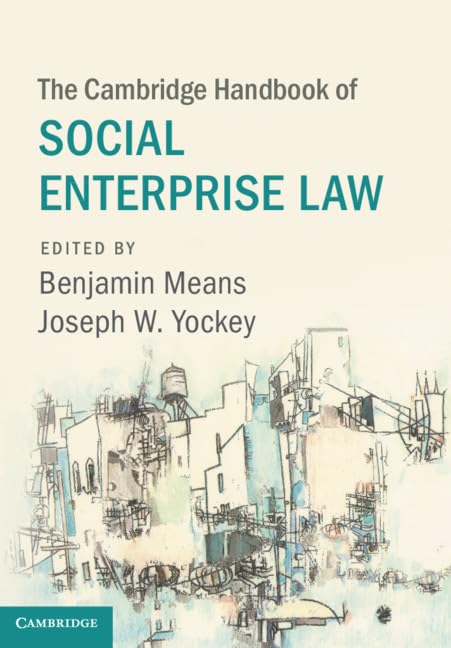
The Cambridge Handbook of Social Enterprise Law by Benjamin Means
Growing numbers of employees, consumers, and investors want companies to be truly good; these stakeholders will accept lower economic returns in order to support companies that prioritize sustainability, fair wages, and fair trade. Unlike charities or non-profit organizations, such companies - or social enterprises - are not only permitted but also expected to produce an economic return for investors. Yet, unlike traditional business ventures, social enterprises have no obligation to maximize profits, even on a long-term basis. In this comprehensive volume, Benjamin Means and Joseph W. Yockey bring together leading legal scholars and practitioners to offer an authoritative guide to social enterprise law and policy. The Cambridge Handbook of Social Enterprise Law takes stock of the field and charts a course for its future development. It should be read by entrepreneurs, investors, practitioners, academics, students and anyone else interested in how companies are evolving to address new demands for capitalism with a conscience.
'This Handbook is a superb collection of articles that thoughtfully examine the efforts of the social-enterprise movement to balance the interests of investors, other stakeholders and societyThese essays provide an articulate analysis of the philosophical underpinnings that go into properly advancing the objectives of these important constituencies. It is a valuable resource for decision makers and others who want to understand each of the competing perspectives.' Randy J. Holland, formerly, Delaware Supreme Court
Benjamin Means is a Professor of Law at the University of South Carolina School of Law. He teaches business associations, mergers and acquisitions, contracts, and family business law. His scholarship appears in journals including the Emory Law Journal, the Georgetown Law Journal, the Vanderbilt Law Review, and the Washington University Law Review. He serves on the executive committee of the American Association of Law Schools Section on Business Associations. Professor Means practiced law at Davis Polk & Wardwell LLP and Satterlee Stephens LLP, and he clerked for Judge Rosemary S. Pooler (United States Court of Appeals for the Second Circuit). Joseph W. Yockey is a Professor of Law and the Michael and Brenda Sandler Faculty Fellow in Corporate Law at the University of Iowa School of Law. He teaches courses on business associations, compliance, and higher education, and he has been voted law school professor of the year. He writes extensively on social enterprise law and corporate governance. Professor Yockey practiced corporate litigation at Sidley Austin LLP in Chicago, Illinois, and he clerked for Judge John Daniel Tinder (formerly United States Court of Appeals for the Seventh Circuit).
| SKU | Unavailable |
| ISBN 13 | 9781107186552 |
| ISBN 10 | 1107186552 |
| Title | The Cambridge Handbook of Social Enterprise Law |
| Author | Benjamin Means |
| Series | Cambridge Law Handbooks |
| Condition | Unavailable |
| Binding Type | Hardback |
| Publisher | Cambridge University Press |
| Year published | 2019-01-03 |
| Number of pages | 462 |
| Cover note | Book picture is for illustrative purposes only, actual binding, cover or edition may vary. |
| Note | Unavailable |