
Cell Separation


Cell Separation
Summary
With contributions by numerous experts
The feel-good place to buy books
- Free US shipping over $15
- Buying preloved emits 41% less CO2 than new
- Millions of affordable books
- Give your books a new home - sell them back to us!
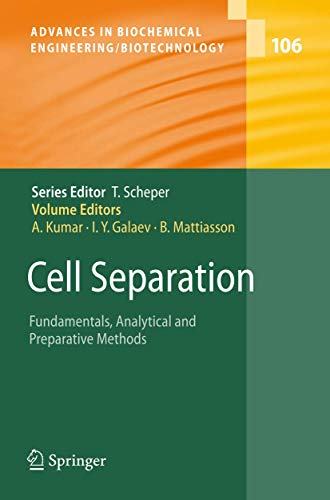
Cell Separation by Ashok Kumar
Cell separation, which was once limited to merely being a basic technique for fractionating different cell populations, has come a long way in the last two decades. New, advanced and more speci?c and selective techniques have emerged as the demand for isolating a speci?c cell type for various biological applications has increased. Ef?cient and cost-effective techniques for fr- tionation and isolation of target cell types are necessary to provide pure cell populations for diagnostics, biotechnological and biomedical applications. One can see a considerable need, both in biomedical research and in di- nostic medicine, for the speci?c separation of a discrete population of cells from a mixture. For example, in the ?eld of tissue engineering, isolation of stemcellsfromtissuesororgansisofparticularlygreatimportance.Moreover, understanding cell developmental pathways becomes increasingly signi?cant as diagnosis and treatment of diseases turns more to the molecular level. The diagnosis of cell-related diseases requires methods of detection, isolation and theanalysisofindividualcells,regardlessoftheirrelativecontentinthetissue. Since cell-based therapies now turn towards more realistic medical options, developing an effective separation system for large-scale cell separation has becomechallengingresearchgoalforcellbiologistsandbiotechnologists.The ideal technique should provide in a short time a good yield of cells with high puritywhile maintaining cellfunction.Despite the growingneed formethods to separate cells into cell subpopulations, the existing cell-separation te- niques stillhave somelimitations when the desired degree ofperformance on apreparativescaleisrequired.Wewillseemoreresearchfocusinthisdirection in the future. The traditional techniques of micro?ltration, ultra?ltration and ultrac- trifugation, which exploit differences in cell size, shape and density, have remainedtheworkhorsesdespitelowspeci?cityandproblemswithscalingup.Dr. Ashok Kumar is a distinguished university professor and chair of Civil and Environmental Engineering at The University of Toledo, Toledo, Ohio. Before coming to Toledo he worked for Syncrude Canada Ltd. as an atmospheric physicist where he developed, planned, and conducted studies related to the dispersion of emissions of a tar sands plant. Dr. Kumar received his Bachelor of Science in Engineering (Honors) from Aligarh University in India (1970), his Master of Applied Science from University of Ottawa, Canada (1972), and his Ph.D. from the University of Waterloo, Canada (1978). He is registered as a Professional Engineer in the Province of Alberta, Canada and is a Diplomat of the American Academy of Environmental Engineers. He is a honorary member of Air and Waste Management Association (A&WMA). Air and Waste Management Association presented him with L. A. Ripperton Award for distinguished achievement as an educator in the field of air pollution control in June 2003. He was conferred honorary membership in A&WMA in 2014. His research work has focused on finding innovative solutions to fundamental and applied problems in air quality, risk analysis, and environmental data analysis. He worked on biodiesel projects from 2004 to 2016 funded by the Department of Transportation through three different DOT university centers.
Dr. Hyun Soo Joo is currently a chief research fellow and director of Department of Atmosphere and Climate Change Research at Korea Environment Institute (KEI) in South Korea. His research area is air quality management, waste management and environmental impact assessment. Dr. Joo received his Bachelor of Science in chemical engineering from Seoul National University, Korea (1989), his Master of Science in environmental assessment from McGill University, Canada (2007), and his Ph.D. in chemical engineering from the Auburn University, USA (1997).
| SKU | Unavailable |
| ISBN 13 | 9783540752622 |
| ISBN 10 | 3540752625 |
| Title | Cell Separation |
| Author | Ashok Kumar |
| Series | Advances In Biochemical Engineering Biotechnology |
| Condition | Unavailable |
| Binding Type | Hardback |
| Publisher | Springer |
| Year published | 2007-11-08 |
| Number of pages | 203 |
| Cover note | Book picture is for illustrative purposes only, actual binding, cover or edition may vary. |
| Note | Unavailable |