


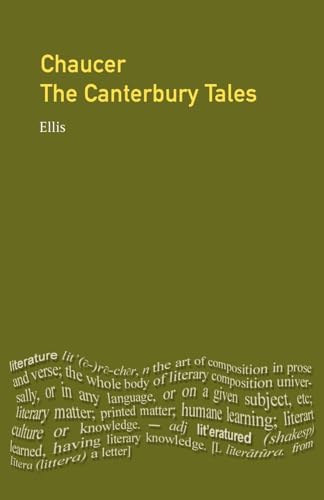
Chaucer: The Canterbury Tales by S Ellis
This new addition to the Longman Critical Readers Series provides an overview of the various ways in which modern critical theory has influenced Chaucer Studies over the last fifteen years. There is still a sense in the academic world, and in the wider literary community, that Medieval Studies are generally impervious to many of the questions that modern theory asks, and that it concerns itself only with traditional philological and historical issues. On the contrary, this book shows how Chaucer, specifically the Canterbury Tales, has been radically and excitingly 'opened up' by feminist, Lacanian, Bakhtinian, deconstructive, semiotic and anthropological theories to name but a few. The book provides an introduction to these new developments by anthologising some of the most important work in the field, including excerpts from book-length works, as well as articles from leading and innovative journals. The introduction to the volume examines in some detail the relation between the individual strengths of each of the above approaches and the ways in which a 'postmodernist' Chaucer is seen as reflecting them all. This convenient single volume collection of key critical analyses of Chaucer, which includes work from some journals and studies that are not always easily available, will be indispensable to students of Medieval Studies, Medieval Literature and Chaucer, as well as to general readers who seek to widen their understanding of the forces behind Chaucer's writing.Geoffrey Chaucer was born in London in around 1342, the son of a wine merchant, and his life was spent in royal government service, therefore his career is particularly extensively documented. By 1357, Chaucer had become a page to the bride of Prince Lionel, Edward III's second son, and it was while in the prince's service that Chaucer was ransomed when he was arrested in France in 1359-60. Philippa, Chaucer's wife, whom he married around. Katherine Swynford, the mistress (c. 1365), was her sister. 1370) and John of Gaunt, Duke of Lancaster's third wife (1396), whose first wife Blanche (d.
The Book of the Duchess, Chaucer's ealrist great poem, is dedicated to her. From 1366 and 1378, Chaucer worked as a customs controller on wool in the port of London, although he also traveled overseas on official business, including two visits to Italy in 1372-3 and 1378. The effect of Chaucer's interaction with Italian literature may be felt in the late 1370s and early 1380s poetry he created, such as The House of Fame, The Parliament of Fowls, and a version of The Knight's Tale, and it reaches its pinnacle in Troilus and Criseyde. Chaucer was a member of parliament for Kent in 1386, but he resigned his customs job the following year, while he was appointed Clerk of the King's Works in 1389 (resigning in 1391).
After finishing Troilus and translating Boethius' De consolatione philosophiae into English prose, Chaucer began his Legend of Good Ladies. He worked on his most ambitious effort, The Canterbury Tales, in the 1390s, but it remained unfinished when he died. Chaucer rented a residence in the Westminster Abbey grounds in 1399, but died in 1400 and was buried there.
| SKU | Unavailable |
| ISBN 13 | 9780582248816 |
| ISBN 10 | 0582248817 |
| Title | Chaucer: The Canterbury Tales |
| Author | S Ellis |
| Series | Longman Critical Readers |
| Condition | Unavailable |
| Binding Type | Paperback |
| Publisher | Taylor & Francis Ltd |
| Year published | 1998-10-02 |
| Number of pages | 256 |
| Cover note | Book picture is for illustrative purposes only, actual binding, cover or edition may vary. |
| Note | Unavailable |