


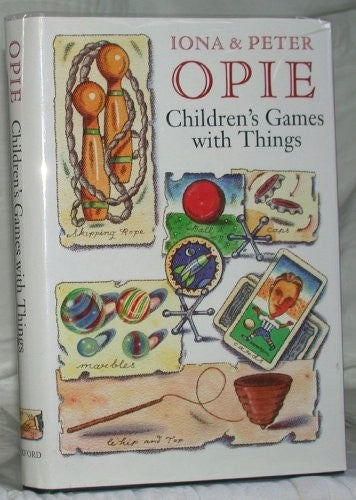
Children's Games with Things by Iona Opie
A study of the nature of children's play, concluding a trilogy of books on the subject. Based on surveys of the 1950s to 1970s, this volume examines children's games that require equipment, such as marbles or skipping. Everything is discussed, from their history to the rhymes accompanying them.
Iona Opie has dedicated her life to collecting and preserving children's rhymes as an art form. I suppose my message in life is 'Nursery rhymes are good for you.' And the sooner you start, the better. I always have one myself every morning. I just open a nursery rhyme book at random. This morning I read:
Taffy was born on a
moonshiney night. His head in a pipskin,
his heels upright. You see, if you acquire a nursery rhyme-ical attitude, you're not at all put out by life's little bumps and bruises--they just seem funny and entirely normal.
Rosemary Wells says, We live in a time when our language is shrinking. Mother Goose, which represents our language at its most innocent, playful, and profound, is in danger of disappearing completely. Rhymes that have been repeated and refined for forty generations are no longer being taught to children. It is a great honor to work with Iona Opie with the hope of preserving these rhymes for many generations more. Rosemary wells lives in New York.
Taffy was born on a
moonshiney night. His head in a pipskin,
his heels upright. You see, if you acquire a nursery rhyme-ical attitude, you're not at all put out by life's little bumps and bruises--they just seem funny and entirely normal.
Rosemary Wells says, We live in a time when our language is shrinking. Mother Goose, which represents our language at its most innocent, playful, and profound, is in danger of disappearing completely. Rhymes that have been repeated and refined for forty generations are no longer being taught to children. It is a great honor to work with Iona Opie with the hope of preserving these rhymes for many generations more. Rosemary wells lives in New York.
| SKU | Unavailable |
| ISBN 13 | 9780192159632 |
| ISBN 10 | 0192159631 |
| Title | Children's Games with Things |
| Author | Iona Opie |
| Condition | Unavailable |
| Binding Type | Hardback |
| Publisher | Oxford University Press |
| Year published | 1998-02-01 |
| Number of pages | 365 |
| Cover note | Book picture is for illustrative purposes only, actual binding, cover or edition may vary. |
| Note | Unavailable |