


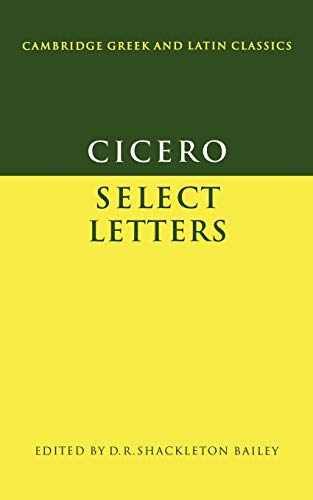
Cicero: Select Letters by Marcus Tullius Cicero
Professor Shackleton Bailey is renowned for his major scholarly editions of Cicero's letters already published by Cambridge University Press. This selection from the complete correspondence is designed specifically for students at universities and in the upper forms at schools, and offers them a representative introduction to one of the most varied and most important literary correspondences in any language. In choosing letters for inclusion the editor concentrates on Cicero as a man and writer and on his relationship with his contemporaries, but he has also included letters which deal with people and events of special significance in the turbulent political history of the period. The edition includes an introduction, the text of the letters with critical notes, and a commentary which gives help with linguistic problems as well as elucidating the historical and social background.
Cicero, Marcus Tullius: - Marcus Tullius Cicero )3 January 106 BC - 7 December 43 BC) was a Roman statesman, lawyer and Academic Skeptic philosopher who played an important role in the politics of the late Republic and vainly tried to uphold republican principles during the crises that led to the establishment of the Roman Empire.[4] His extensive writings include treatises on rhetoric, philosophy and politics, and he is considered one of Rome's greatest orators and prose stylists.[5][6] He came from a wealthy municipal family of the Roman equestrian order, and served as consul in the year 63 BC. His influence on the Latin language was immense: it has been said that subsequent prose was either a reaction against or a return to his style, not only in Latin but in European languages up to the 19th century.[7][8] Cicero introduced into Latin the arguments of the chief schools of Hellenistic philosophy and created a Latin philosophical vocabulary with neologisms such as evidentia, [9] humanitas, qualitas, quantitas, and essentia, [10] distinguishing himself as a translator and philosopher. Though he was an accomplished orator and successful lawyer, Cicero believed his political career was his most important achievement. It was during his consulship that the second Catilinarian conspiracy attempted to overthrow the government through an attack on the city by outside forces, and Cicero suppressed the revolt by summarily and controversially executing five conspirators. During the chaotic latter half of the 1st century BC marked by civil wars and the dictatorship of Gaius Julius Caesar, Cicero championed a return to the traditional republican government. Following Julius Caesar's death, Cicero became an enemy of Mark Antony in the ensuing power struggle, attacking him in a series of speeches. He was proscribed as an enemy of the state by the Second Triumvirate and consequently executed by soldiers operating on their behalf in 43 BC after having been intercepted during an attempted flight from the Italian peninsula. His severed hands and head were then, as a final revenge of Mark Antony, displayed on the Rostra. Petrarch's rediscovery of Cicero's letters is often credited for initiating the 14th-century Renaissance in public affairs, humanism, and classical Roman culture.[11] According to Polish historian Tadeusz Zieliński, the Renaissance was above all things a revival of Cicero, and only after him and through him of the rest of Classical antiquity.[12] The peak of Cicero's authority and prestige came during the 18th-century Enlightenment, [13] and his impact on leading Enlightenment thinkers and political theorists such as John Locke, David Hume, Montesquieu and Edmund Burke was substantial.[14] His works rank among the most influential in European culture, and today still constitute one of the most important bodies of primary material for the writing and revision of Roman history, especially the last days of the Roman Republic.
| SKU | Unavailable |
| ISBN 13 | 9780521295246 |
| ISBN 10 | 0521295246 |
| Title | Cicero: Select Letters |
| Author | Marcus Tullius Cicero |
| Series | Cambridge Greek And Latin Classics |
| Condition | Unavailable |
| Binding Type | Paperback |
| Publisher | Cambridge University Press |
| Year published | 1980-07-03 |
| Number of pages | 248 |
| Cover note | Book picture is for illustrative purposes only, actual binding, cover or edition may vary. |
| Note | Unavailable |