
The Civil Rights Movement and the Logic of Social Change


Summary
The feel-good place to buy books
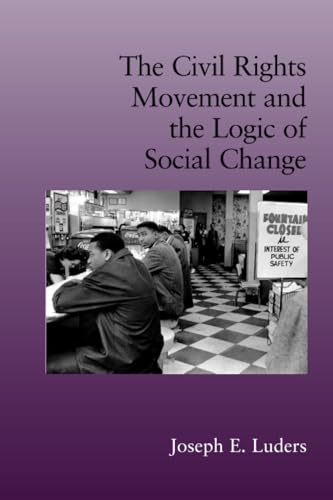
The Civil Rights Movement and the Logic of Social Change by Joseph E Luders
Social movements have wrought dramatic changes upon American society. This raises the question: Why do some movements succeed in their endeavors while others fail? Luders answers this question by introducing an analytical framework that begins with a shift in emphasis away from the characteristics of movements toward the targets of protests and affected bystanders and why they respond as they do. This shift brings into focus how targets and other interests assess both their exposure to movement disruptions as well as the costs of conceding to movement demands. From this point, diverse outcomes stem not only from a movement's capabilities for protest but also from differences among targets and others in their vulnerability to disruption and the substance of movement goals. Applied to the civil rights movement, this approach recasts conventional accounts of the movement's outcome in local struggles and national politics and clarifies the broader logic of social change.
“The Civil Rights Movement and the Logic of Social Change is one of the best-crafted books I have seen in a whileIt advances our knowledge in many ways, bringing into the fray social movement targets, third parties, economic actors and recasting multiple aspects of conventional accounts of the mobilization of the U.S. civil rights movement…Perhaps the greatest strength of this piece is that it is theoretically nuanced, empirically rich and historically challenging analysis that will provoke much debate and generate renewed attention by both social movements and U.S. civil rights scholars.” – Lorenzo Bosi, European University Institute, Mobilization
“This is an important book for anyone interested in the ways in which social movements affect politics. Luders does a masterful job of synthesizing various literatures on interest groups, social movements, public opinion, and political institutions. In doing so, he has written a fascinating, accessible book and presented a fresh interpretation of one of the most important episodes in American history.” – Christopher S. Parker, University of Washington, Perspectives on Politics
“Luders's study underscores that social movements are exceedingly complicated, that there is no single path to victory, and that there is an incredible degree of variability and complexity in terms of the many factors involved in determining the responses of movement targets and the ultimate outcome of specific campaigns. In this way, the book provides a welcome reminder that the targets of social movements often face the powerful crosscurrents of competing disruption costs and reactive concession costs...Luders's analysis sheds considerable light on both the successes and failures of the southern civil rights movement and more effectively explains the broad variation in southern white responses to movement demands.” – Patrick Jones, H-1960s
“This analytically incisive, elegantly argued, and empirically rich book profoundly enriches our understanding of why and when social movements gain ground and win results, and when they do not. As a deeply illuminating analysis of civil rights struggles, it reverses traditional orientations to focus on strategic responses by direct movement targets and third-parties who make calculations with regard to political economy and electoral outcomes. Convincingly demonstrating how strategic reactions can matter as much to results as strategic actions, this gripping volume advances our understanding of recent American history and powerfully adds to theoretical work on collective contention.” – Ira Katznelson, Columbia University
“The Civil Rights Movement and the Logic of Social Change represents a major theoretical advance in studies of social movements and political change. It is smart and original, and will reorient a great deal of scholarship on social movements. Joseph Luders shows that movement targets generally have to worry about more than just one challenging movement, and often face cross-pressures. Social movement activists win not only by persuading their targets, making it possible for authorities to manage other pressures when they offer concessions. Luders’s analysis is powerfully articulated in the case of civil rights, but his basic premises should apply to a wide range of other cases. This is a fascinating and important book.” – David S. Meyer, University of California, Irvine
“The Civil Rights Movement and the Logic of Social Change presents a carefully crafted and convincing argument about the conditions under which social movements will change the entities which they target. Luders presents a fresh approach to this question by suggesting that scholars account for the different kinds of costs that movements incur on different kinds of targets and by bringing our attention to the role of third parties in the ultimate attainment of movement goals. Luders offers a nuanced and detailed account of the U.S. Civil Rights Movement and demonstrates how his approach sheds light on the victories and defeats of this movement. This ambitious book is an important contribution to the rapidly-growing area of scholarship focusing on the outcomes or consequences of social movement and it should be read by sociologists, political scientists, and historians alike.” – Sarah Soule, Stanford University
“Luders offers the simple and elegant theory that social movements will achieve their goals when they can to impose high disruption costs on their targets, when the costs of compliance are modest. The theory is convincingly illustrated with an extensive analysis of the American Civil Rights Movement. A smart and powerful contribution to the theory of contestation.” – Mark Warren, University of British Columbia
“This is an important book for anyone interested in the ways in which social movements affect politics. Luders does a masterful job of synthesizing various literatures on interest groups, social movements, public opinion, and political institutions. In doing so, he has written a fascinating, accessible book and presented a fresh interpretation of one of the most important episodes in American history.” – Christopher S. Parker, University of Washington, Perspectives on Politics
“Luders's study underscores that social movements are exceedingly complicated, that there is no single path to victory, and that there is an incredible degree of variability and complexity in terms of the many factors involved in determining the responses of movement targets and the ultimate outcome of specific campaigns. In this way, the book provides a welcome reminder that the targets of social movements often face the powerful crosscurrents of competing disruption costs and reactive concession costs...Luders's analysis sheds considerable light on both the successes and failures of the southern civil rights movement and more effectively explains the broad variation in southern white responses to movement demands.” – Patrick Jones, H-1960s
“This analytically incisive, elegantly argued, and empirically rich book profoundly enriches our understanding of why and when social movements gain ground and win results, and when they do not. As a deeply illuminating analysis of civil rights struggles, it reverses traditional orientations to focus on strategic responses by direct movement targets and third-parties who make calculations with regard to political economy and electoral outcomes. Convincingly demonstrating how strategic reactions can matter as much to results as strategic actions, this gripping volume advances our understanding of recent American history and powerfully adds to theoretical work on collective contention.” – Ira Katznelson, Columbia University
“The Civil Rights Movement and the Logic of Social Change represents a major theoretical advance in studies of social movements and political change. It is smart and original, and will reorient a great deal of scholarship on social movements. Joseph Luders shows that movement targets generally have to worry about more than just one challenging movement, and often face cross-pressures. Social movement activists win not only by persuading their targets, making it possible for authorities to manage other pressures when they offer concessions. Luders’s analysis is powerfully articulated in the case of civil rights, but his basic premises should apply to a wide range of other cases. This is a fascinating and important book.” – David S. Meyer, University of California, Irvine
“The Civil Rights Movement and the Logic of Social Change presents a carefully crafted and convincing argument about the conditions under which social movements will change the entities which they target. Luders presents a fresh approach to this question by suggesting that scholars account for the different kinds of costs that movements incur on different kinds of targets and by bringing our attention to the role of third parties in the ultimate attainment of movement goals. Luders offers a nuanced and detailed account of the U.S. Civil Rights Movement and demonstrates how his approach sheds light on the victories and defeats of this movement. This ambitious book is an important contribution to the rapidly-growing area of scholarship focusing on the outcomes or consequences of social movement and it should be read by sociologists, political scientists, and historians alike.” – Sarah Soule, Stanford University
“Luders offers the simple and elegant theory that social movements will achieve their goals when they can to impose high disruption costs on their targets, when the costs of compliance are modest. The theory is convincingly illustrated with an extensive analysis of the American Civil Rights Movement. A smart and powerful contribution to the theory of contestation.” – Mark Warren, University of British Columbia
Joseph Luders is Gottesman Assistant Professor of Political Science at Yeshiva University. His research focuses on social movements, civil rights politics and policy, and American political development.
| SKU | Unavailable |
| ISBN 13 | 9780521133395 |
| ISBN 10 | 0521133394 |
| Title | The Civil Rights Movement and the Logic of Social Change |
| Author | Joseph E Luders |
| Series | Cambridge Studies In Contentious Politics |
| Condition | Unavailable |
| Binding Type | Paperback |
| Publisher | Cambridge University Press |
| Year published | 2010-01-25 |
| Number of pages | 260 |
| Cover note | Book picture is for illustrative purposes only, actual binding, cover or edition may vary. |
| Note | Unavailable |