


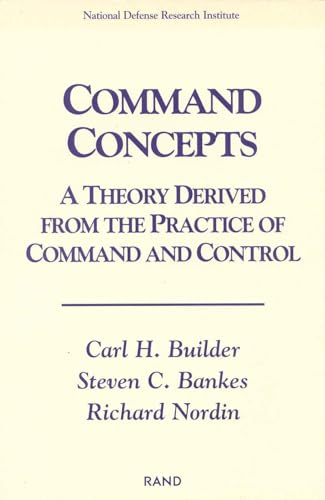
Command Concepts by Carl H Builder
The qualities of commanders and their ideas are more important to a general theory of command and control than are the technical and architectural qualities of their computers and communications systems. This theory separates the art of command and control (C2) from the hardware and software systems that support C2. It centers on the idea of a command concept, a commander's vision of a military operation that informs the making of command decisions during that operation. The theory suggests that the essential communications up and down the chain of command can (and should) be limited to disseminating, verifying, or modifying command concepts. The theory also suggests, as an extreme case, that an ideal command concept is one that is so prescient, sound, and fully conveyed to subordinates that it would allow the commander to leave the battlefield before the battle commences, with no adverse effect upon the out-come. This report advances a theory about military
Builder, Carl H.: -
Carl H. Builder was a senior staff member at RAND, and specialized in strategy formation and analysis. He is the author of The Masks of War: American Military Styles in Strategy and Analysis, and wrote extensively on nuclear issues, the military, institutional analysis, and technological and societal futures.
| SKU | Unavailable |
| ISBN 13 | 9780833024503 |
| ISBN 10 | 0833024507 |
| Title | Command Concepts |
| Author | Carl H Builder |
| Condition | Unavailable |
| Binding Type | Paperback |
| Publisher | RAND |
| Year published | 1999-10-13 |
| Number of pages | 144 |
| Cover note | Book picture is for illustrative purposes only, actual binding, cover or edition may vary. |
| Note | Unavailable |