


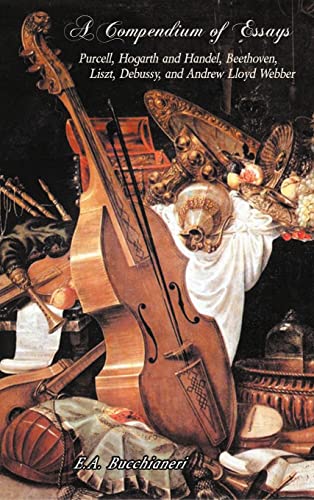
A Compendium of Essays by E A Bucchianeri
A Compendium of Essays is a unique collection presenting new and intriguing philosophical analysis on several renowned composers and their work from the Baroque period to contemporary times. E.A. Bucchianeri discusses familiar topics that include Purcell's opera Dido and Aeneas, William Hogarth's painting The Rake's Lev e featuring Handel, a selection of Beethoven's symphonies, Liszt's Faust Symphony and the conception of the symphonic poem genre, Orientalism and Debussy's progressive style, and Andrew Lloyd Webber's musical The Phantom of the Opera as an example of the 'Musical Theatre Renaissance'. In Many instances, the author offers different theories that are original, informative and will appeal to all music lovers, professionals and amateurs, or those who wish to explore music philosophy in general. Admirers of Hogarth and his artwork will also find A Compendium of Essays interesting due to a novel interpretation of The Rake's Lev e from a musical perspective. Illustration and musical examples are included in several of the essays, enriching the author's analytical theories and philosophical observations. A Compendium of Essays will prove an additional treasure to any library.Features the following essays:
Purcell's Dido and Aeneas: A Musical Exemplum for Young Gentlewomen
Hogarth, Handel, and 'The Lev e' from 'The Rakes Progress': A Satirical Portrait Worth a Thousand Words
The Symphonies of Beethoven: Historical and Philosophical Reflections through Music
Liszt, Goethe, the 'Faust Symphony', and the Symphonic Poem: 'The Word Must Become the Deed'
Orientalism, Music and Debussy: West Meets East
Andrew Lloyd Webber's 'Phantom of the Opera': An Example of the 'Musical Theatre Renaissance'
... In the 'Symphonies of Beethoven: Historical and Philosophical Reflections Through Music', Bucchianeri posits that Beethoven's symphonies reflect the composer's perception of his own world and his attitudes toward society and culture. That this perception changed over time is revealed by the stylistic progression of the works. Beethoven's earliest works in the genre contain the element of the 'sublime', an aesthetic concept earmarked by grand concepts, powerful emotions, imagery, dignity, and elevation. Drawing on the philosophy of Edmund Burke, the author describes the sublime as 'large and unfathomable, rough and rugged, terrifying and painful, without actually experiencing this intangible state.' The opening movements of the first two symphonies show elements of the noble concept of the 'sublime'. In the Third and and Fifth Symphonies Beethoven expanded on the sublime style to epic proportions; in the Sixth he integrated the concept that 'all things sublime are both ancient and new, as in nature.' By the Ninth, Beethoven turned to the concept of the sublime as unfathomable as the heavens. Here the author offers an interpretation of the Ninth in relation to Beethoven's character and philosophies. The book includes a select bibliography and index for all the essays. - Patricia Stroh, the Beethoven Journal, San Jose University
| SKU | Unavailable |
| ISBN 13 | 9789899684423 |
| ISBN 10 | 9899684422 |
| Title | A Compendium of Essays |
| Author | E A Bucchianeri |
| Condition | Unavailable |
| Binding Type | Hardback |
| Publisher | Batalha Publishers |
| Year published | 2010-08-13 |
| Number of pages | 198 |
| Cover note | Book picture is for illustrative purposes only, actual binding, cover or edition may vary. |
| Note | Unavailable |