
A Concrete Introduction to Higher Algebra


Summary
The feel-good place to buy books
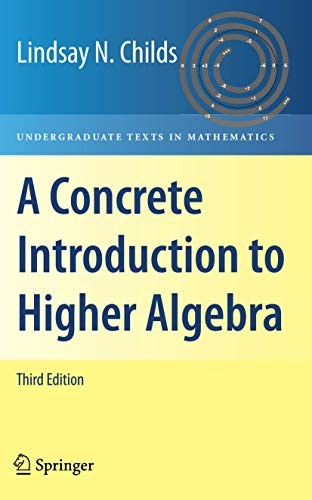
A Concrete Introduction to Higher Algebra by Lindsay N Childs
This book is written as an introduction to higher algebra for students with a background of a year of calculus. The first edition of this book emerged from a set of notes written in the 1970sfor a sophomore-junior level course at the University at Albany entitled Classical Algebra. The objective of the course, and the book, is to give students enough experience in the algebraic theory of the integers and polynomials to appre- ciate the basic concepts of abstract algebra. The main theoretical thread is to develop algebraic properties of the ring of integers: unique factorization into primes, congruences and congruence classes, Fermat's theorem, the Chinese remainder theorem; and then again for the ring of polynomials. Doing so leads to the study of simple field extensions, and, in particular, to an exposition of finite fields. Elementary properties of rings, fields, groups, and homomorphisms of these objects are introduced and used as needed in the development. Concurrently with the theoretical development, the book presents a broad variety of applications, to cryptography, error-correcting codes, Latin squares, tournaments, techniques of integration, and especially to elemen- tary and computational number theory. A student who asks, Why am I learning this?, willfind answers usually within a chapter or two. For a first course in algebra, the book offers a couple of advantages. - By building the algebra out of numbers and polynomials, the book takes maximal advantage of the student's prior experience in algebra and arithmetic. New concepts arise in a familiar context.From the reviews:
"The user-friendly exposition is appropriate for the intended audienceExercises often appear in the text at the point they are relevant, as well as at the end of the section or chapter. Hints for selected exercises are given at the end of the book. There is sufficient material for a two-semester course and various suggestions for one-semester courses are provided. Although the overall organization remains the same in the second edition¿Changes include the following: greater emphasis on finite groups, more explicit use of homomorphisms, increased use of the Chinese remainder theorem, coverage of cubic and quartic polynomial equations, and applications which use the discrete Fourier transform." MATHEMATICAL REVIEWS
From the reviews of the third edition:
“This book is an introduction to abstract algebra. … it has enough material to give the instructor flexibility in the course. It is a good book for the serious student to have in his/her library. … I would recommend this especially for self-study, as the book reads exactly as a good teacher talks to a class.” (Philosophy, Religion and Science Book Reviews, bookinspections.wordpress.com, October, 2013)
"This book can serve as both an introduction to number theory and abstract algebra, sacrifices have to be made with respect to its algebraic content. … the book has been written with a high degree of rigor and accuracy and I definitely recommend it for consideration as the basis of an alternative route into abstract algebra and its applications." (The Mathematical Association of America, April, 2009)
"The target audience remains students requiring a substantial introduction to the elements of university-level algebra. … the text proceeds throughout on a foundation built from the students’ familiarity with integers and polynomials over fields. Great care is taken to proceed to abstract concepts by way of familiar examples, and agreat many exercises are provided throughout the text. … A noteworthy feature of the book is the inclusion of extensive material on applications, to such topics as cryptography and factoring polynomials." (Kenneth A. Brown, Mathematical Reviews, Issue 2009 i)
Lindsay N. Childs is Professor Emeritus at the University of Albany where he earned recognition as a much-loved mentor of students, and as an expert in Galois field theory. Capping his tenure at Albany, he was named a Collins Fellow for his extraordinary devotion to the University at Albany and the people in it over a sustained period of time. Post University of Albany, Professor Childs has taught a sequence of online courses whose content evolved into this book. Lindsay Childs is author of A Concrete Introduction to Higher Algebra, published in Springer's Undergraduate Texts in Mathematics series, as well as a monograph, Taming Wild Extensions: Hopf Algebras and Local Galois Module Theory (American Mathematical Society), and more than 60 research publications in abstract algebra.
| SKU | Unavailable |
| ISBN 13 | 9780387745275 |
| ISBN 10 | 0387745270 |
| Title | A Concrete Introduction to Higher Algebra |
| Author | Lindsay N Childs |
| Series | Undergraduate Texts In Mathematics |
| Condition | Unavailable |
| Binding Type | Hardback |
| Publisher | Springer-Verlag New York Inc. |
| Year published | 2008-11-26 |
| Number of pages | 604 |
| Cover note | Book picture is for illustrative purposes only, actual binding, cover or edition may vary. |
| Note | Unavailable |