


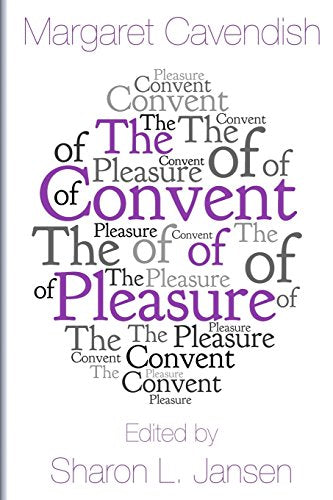
The Convent of Pleasure by Sharon L Jansen
Margaret Lucas Cavendish, Duchess of Newcastle-upon-Tyne was born in 1623 in Colchester, Essex into a family of comfortable means.As the youngest of eight children she spent much time with her siblings. Margaret had no formal education but she did have access to scholarly libraries and tutors, although she later said the children paid little attention to the tutors, who were there 'rather for formality than benefit'.
From an early age Margaret was already assembling her thoughts for future works despite the then conditions of society that women did not partake in public authorship. For England it was also a time of Civil War. The Royalists were being pushed back and Parliamentary forces were in the ascendancy.
Despite these obvious dangers, when Queen Henrietta Maria was in Oxford, Margaret asked her mother for permission to become one of her Ladies-in-waiting. She was accepted and, in 1644, accompanied the Queen into exile in France. This took her away from her family for the first time.
Despite living at the Court of the young King Louis XIV, life for the young Margaret was not what she expected. She was far from her home and her confidence had been replaced by shyness and difficulties fitting in to the grandeur of her surroundings and the eminence of her company.
Margaret told her mother she wanted to leave the Court. Her mother was adamant that she should stay and not disgrace herself by leaving. She provided additional funds for her to make life easier. Margaret remained. It was now also that she met and married William Cavendish who, at the time, was the Marquis of Newcastle (and later Duke). He was also 30 years her senior and previously married with two children.
As Royalists, a return to life in England was not yet possible. They would remain in exile in Paris, Rotterdam and Antwerp until the restoration of the crown in 1660 although Margaret was able to return for attention to some estate matters.
Along with her husband's brother, Sir Charles Cavendish, she travelled to England after having been told that her husband's estate (taken from him due to his being a royalist) was to be sold and that she, as his wife, would receive some benefit of the sale. She received nothing. She left England to be with her husband again.
The couple were devoted to each other. Margaret wrote that he was the only man she was ever in love with, loving him not for title, wealth or power, but for merit, justice, gratitude, duty, and fidelity. She also relied upon him for support in her career. The marriage provided no children despite efforts made by her physician to overcome her inability to conceive.
Margaret's first book, 'Poems and Fancies', was published in 1653; it was a collection of poems, epistles and prose pieces which explores her philosophical, scientific and aesthetic ideas.
For a woman at this time writing and publishing were avenues they had great difficulty in pursuing. Added to this was Margaret's range of subjects. She wrote across a number of issues including gender, power, manners, scientific method, and philosophy.
She always claimed she had too much time on her hands and was therefore able to indulge her love of writing. As a playwright she produced many works although most are as closet dramas. (This is a play not intended to be performed onstage, but instead read by a solitary reader or perhaps out loud in a small group. For Margaret the rigours of exile, her gender and Cromwell's closing of the theatres mean this was her early vehicle of choice and, despite these handicaps, she became one of the most well-known playwrights in England)
Her utopian romance, 'The Blazing World', (1666) is one of the earliest examples of science fiction. Margaret also published extensively in natural philosophy and early modern science; at least a dozen books.
She was the first woman to attend a meeting at Royal Society of London in 1667 and she critic
Margaret Cavendish (1623-1673) was a pioneering woman and author in the seventeenth century. She was an aristocracy from England who was also a philosopher, scientist, novelist, poet, and dramatist. Cavendish was not hesitant about her studies in philosophy and science, despite the fact that they are male-dominated subjects, and she communicated her thoughts and results on each topic in her written work. Despite the fact that Cavendish wrote during a period when women were discouraged from doing so, she always published under her own name rather than anonymously. Cavendish's work touched on a variety of themes and topics, including gender, sexuality, power, science, philosophy, and animal activism. The Blazing World, one of her early works, is regarded as one of the earliest examples of the science fiction genre.
| SKU | Unavailable |
| ISBN 13 | 9780692654620 |
| ISBN 10 | 0692654623 |
| Title | The Convent of Pleasure |
| Author | Sharon L Jansen |
| Condition | Unavailable |
| Binding Type | Paperback |
| Publisher | Saltar's Point Press |
| Year published | 2016-04-07 |
| Number of pages | 204 |
| Cover note | Book picture is for illustrative purposes only, actual binding, cover or edition may vary. |
| Note | Unavailable |