


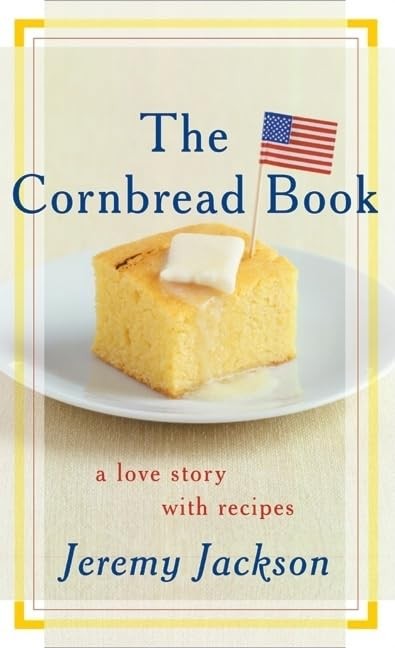
The Cornbread Book by Jeremy Jackson
Jeremy Jackson has four goals:
- Make cornbread one word. Once and for all.
- Have cornbread named the official bread of the United States.
- Find a wife.
- Think outside the box of cornmeal about the Possibilities, potentialities, and promises of cornbread.
Cornbread is the American bread. The by-the-people-for-the-people bread. So it should be put forth to the people with humor. And a whole lot of butter.
The Cornbread Book does just that with recipes for cornbreads, fritters, hush puppies, and biscuits. Cornbreads of the sweet persuasion appear, too, from biscotti to pound cake. And there are yeast breads such as Anadama Batter Bread and Cornmeal Pizza Dough. Don't forget timeless favorites like spoonbread, buttermilk cornbread, and popovers. Not to mention Gospel Buns, Sweet Potato Cupcakes, and Honey Snail (which doesn't come within ten miles of an actual snail).
Cornbread doesn't even have to be made with cornmeal. Hominy-Leek Monkey Bread has riced hominy. And Jeremy is as proud as a peacock to have come up with three yeast breads made with flour he milled from popped popcorn (Popcorn White Loaf, Popcorn Pita Bread, and Popcorn Focaccia). In the unlikely event you have any leftover cornbread, Jeremy has recipes for cornbread salad, croutons, and dressing.
And if you ever meet Jeremy, he might just sing you "The Cornbread Song" . . .
Though I was born in Ohio, I grew up with my family on a farm in the Ozark borderlands of Missouri. We raised cattle and hay and had a garden the size of Texas. At various times we had horses, cattle, a pig, sheep, chickens, ducks, and a pony. We ate a lot of these animals, but not the pony. We also had wild blackberries and persimmons and walnuts on our farm. And a pear tree. And we caught fish in our ponds. We ate some of them, too. For some crazy reason, I headed off to Vassar College, thinking that I would become a writer. Unfortunately, I did. It was all downhill from there, though the sex was good. From Vassar I went straight into the Iowa Writers' Workshop, where I wrote brilliant stories about bunnies, marbles, and a talking mailbox named Ruth. Then I spent a year writing a novel and a screenplay. Then I went and taught English back at Vassar for two years. Being a professor was a mind-numbing experience, though the sex was good. I quit that job and started being a writer full time, which was very much like being a writer part time except that it took a lot more time and I felt much more guilty when I didn't write anything. I moved from Poughkeepsie back to Iowa, which is kind of like moving from the outer circles of hell to the Garden of Eden. Not Your Average Memoirist: Six Questions with Jeremy Jackson
by Will Wlizlo Jeremy Jackson isn't your typical memoirist. He grew up in rural Missouri and had a mostly happy childhood, unspoiled by the drug addictions, abuse, or financial hardship we've come to expect from the genre. His focus, instead, is on the ordinary hard times we've almost all faced--the death of a loved one, the fade of a fledgling romance. And yet he evokes the events with a bittersweet clarity, expansive tenderness, and uncommon wisdom that transforms the everyday into the sacred and the personal into the universal. In I Will Not Leave You Comfortless, Jackson chronicles his unforgettable eleventh year, when he lost more than a girlfriend and a Pinewood Derby race. He lost his innocence. Here, Jackson talks about unboxing his childhood memories, not seeing the weather, and almost getting married in fourth grade. Milkweed Editions: In the memoir, you take the freshman composition maxim write what you know to a whole new level. How did you remember the past with such clarity? Jeremy Jackson: I wrote Comfortless in part as a way to discover and understand a fuller version of the family's story than I understood at the time, as a boy. Sort of a write what you know plus write toward what you want to know. My memory of my childhood is good, but the book creates an illusion that I remember it spectacularly well. Luckily, I had access to a trove of family documents from the time I was writing about. My most important sources included items like my family's daily calendars, my grandmother's journals, and dozens of dated and labeled photographs. But I had many, many more things, like a tape recording of my grandmother's funeral, my sister's journal, notes girls at school had written to me, and the notepad that sat at my grandmother's hospital bedside for months. Additionally, my parents were excellent sources, because they recalled many events that I wasn't even present for. So my research helped immensely in recreating a fuller version of the family story than I remember. While writing Comfortless, what was a once-lost childhood memory you unearthed that was especially pleasurable to remember? There's hardly a page of the book (at least the ones where I am present) that doesn't have some tidbit that I retrieved from the deep reaches of memory. The time our little black cat rode on top of the car to town, for example. Or how I built my Pinewood Derby car backwards that year, and didn't realize it until the night of the races. Buying earrings for the girl I had a crush on. The way my grandmother would give me cut-up brown paper bags to draw or paint on. Pick a page and I'll point out something that I had semi-forgotten but recovered during the writing of the book. In the memoir, life-changing events like your grandmother's death are presented alongside less weighty memories like losing the Pinewood Derby. As inconsequential as the latter may seem, the experience can be just as memorable as the former. Why do you think everyday experiences loom so large in childhood? Oh, the world is fresher when you're a kid, isn't it? Or, really, you're fresher, and the things that are happening to you--big and small--are being etched right into your brain. Your parents were forced to take care of both their young children and their aging parents. What did you learn about caregiving and family resilience during this time? I think one of the things the book does is show how the generations--of any family--move forward inexorably and simultaneously. One of the structural tensions in the book is the contrast between my grandmother's story (the older generation passing on) and my sister's story (the younger generation coming into maturity). The stories in a family can be both sad and triumphant at the same time. During the writing and publication of the book, I also got married and became a father, so I entered a new life stage, and this made me appreciate and understand my parents' roles as the middle generation taking care of both the younger generation and the older generation. Comfortless is as much a story of your family as it is of everything in your environment--volatile summer storms, fresh cow's milk, wild pink mulberries, the smell of Missouri soil. How does place influence you as a writer and as a Midwesterner? For me, setting is one of the most important and dynamic parts of a story. I love the Midwestern landscape and weather. I lived on the East coast for six years, and I was constantly frustrated that I couldn't get a good view of the sky or horizon through all the trees and buildings. I couldn't see the weather! I couldn't see storm clouds coming, which was upsetting a) because you needed to see them coming so you could be prepared and b) they are beautiful. In one particularly comic scene, you're standing in the schoolyard, waiting to get married to Toni Renken, a girl in your class. In retrospect, if you could live the crush all over again, what would you do differently? I still find the concept of our semi-arranged playground marriage to be hilarious. A few years ago I talked with one of the girls who helped organize the wedding, and she recalled that she and some of the other girls got into a little bit of trouble over the whole thing. I think the teachers didn't like them playing at being grown ups so literally. But really, it just wasn't meant to be. You can't force a thing like that.
| SKU | Unavailable |
| ISBN 13 | 9780060096793 |
| ISBN 10 | 0060096799 |
| Title | The Cornbread Book |
| Author | Jeremy Jackson |
| Condition | Unavailable |
| Binding Type | Hardback |
| Publisher | HarperCollins Publishers Inc |
| Year published | 2003-03-25 |
| Number of pages | 144 |
| Prizes | Short-listed for James Beard Foundation Book Awards (Single Subject) 2004 |
| Cover note | Book picture is for illustrative purposes only, actual binding, cover or edition may vary. |
| Note | Unavailable |