


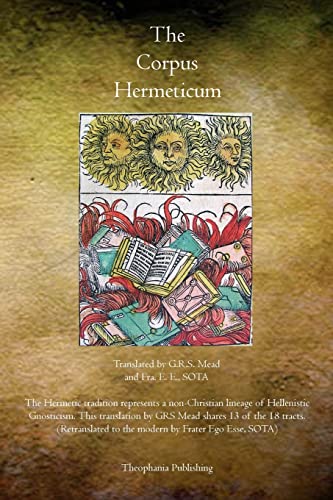
The Corpus Hermeticum by G R S Mead
This work has been selected by scholars as being culturally important and is part of the knowledge base of civilization as we know it.
This work is in the public domain in the United States of America, and possibly other nations. Within the United States, you may freely copy and distribute this work, as no entity (individual or corporate) has a copyright on the body of the work.
Scholars believe, and we concur, that this work is important enough to be preserved, reproduced, and made generally available to the public. To ensure a quality reading experience, this work has been proofread and republished using a format that seamlessly blends the original graphical elements with text in an easy-to-read typeface.
We appreciate your support of the preservation process, and thank you for being an important part of keeping this knowledge alive and relevant.
George Robert Stowe Mead was an significant member of the Theosophical Society as well as the creator of the Quest Society. He was an English author, editor, translator, and influential member of the Theosophical Society. He began studying mathematics at St John's College, Cambridge, after demonstrating academic potential. He eventually shifted his education to Classics, where he learned a great deal of Greek and Latin. While still at Cambridge University, Mead read Alfred Percy Sinnett's Esoteric Buddhism and began working as a public school master the next year. Mead was inspired by this extensive theosophical exposition of eastern religion to contact two London theosophists, Bertam Keightly and Mohini Chatterji, and eventually join the Theosophical Society.
In 1884, Mead joined the Theosophical Society as a member. In 1889, he left his teaching job to become Blavatsky's private secretary, as well as the joint-secretary of the Theosophical Society's Esoteric Division. Whilst his study and publications continued to connect with eastern religion, he became increasingly interested in western esotericism of religion and philosophy, particularly Neoplatonism, Gnosticism, and Hermeticism, as he contributed intellectually to the Theosophical Society. He became the sole editor of The Theosophical Review in 1907 (as Lucifer was renamed in 1897) after several contributions as joint editor to the Theosophical Society's Lucifer magazine.
Mead resigned in February 1909, in protest over Annie Besant's reinstatement of Charles Webster Leadbeater as a member of the society. While this may have precipitated Mead's resignation, his dissatisfaction with the Theosophical Society's dogmatism may also have played a role in his decision. During the previous twenty-five years, he had been a member. Mead created the Quest Society in March 1909, with 150 Theosophical Society defectors and 100 new members.
The Quest Society held talks in Kensington Town Hall in central London, but its main focus was on the publication of The Quest: A Quarterly Review, which ran from 1909 to 1931 and featured a large number of writers. Ezra Pound, W.B. Yeats, and others were among those impacted by Mead. Robert Duncan, Yeats, Hermann Hesse, Kenneth Rexroth Carl Gustav Jung was influenced by George Mead, according to Deirdre Bair's famous biography of Jung.
| SKU | Unavailable |
| ISBN 13 | 9781770830752 |
| ISBN 10 | 1770830758 |
| Title | The Corpus Hermeticum |
| Author | G R S Mead |
| Condition | Unavailable |
| Binding Type | Paperback |
| Publisher | Theophania Publishing |
| Year published | 2011-05-02 |
| Number of pages | 74 |
| Cover note | Book picture is for illustrative purposes only, actual binding, cover or edition may vary. |
| Note | Unavailable |