


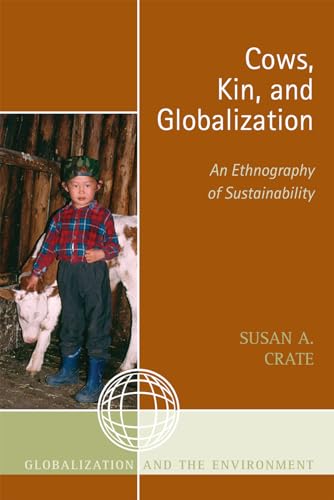
Cows, Kin, and Globalization by Susan Alexandra Crate
Crate presents the first cultural ecological study of a Siberian people: the Viliui Sakha, contemporary horse and cattle agropastoralists in northeastern Siberia. The author links the local and global economic forces, and provides an intimate view of how a seemingly remote and isolated community is directly affected by the forces of modernization and globalization. She details the severe environmental and historical factors that continue to challenge their survival, and shows how the multi-million dollar diamond industry, in part run by ethnic Sakha, raises issues of ethnic solidarity and indigenous rights as well as environmental impact. Her new book addresses key topics of interest to both economic and environmental anthropology, and to practitioners interested in sustainable rural development, globalization, indigenous rights in Eurasia, and post-Soviet and environmental issues.
Through this innovative multi-sited ethnography of complex local and global indigenous sustainability, we see how under diamond mining the Viliui Sakha were transformed from their pre-Soviet subsistence strategies into the Soviet working class then to a post-Soviet household production system founded upon having and knowing landThe Viliui Sakha reemerged as victors of sustainability. This is a perceptive ethnography of sustainability that passionately advances indigenous peoples' rights to socioecological equity, cultural survival, and political devolution. -- Dr. David Hyndman, Author of: Ancestral Rain Forests and the Mountain of Gold: Indigenous Peoples and Mining in New Guinea.
Cows, Kin, and Globalization is three books in one: a vivid description of the Sakha people of Siberia, a comparative review of the impact of high-value mining on indigenous cultures, and a thoughtful exploration of the possibilities and perils of reconciling diamond mining and local populations. Because it brings these topics together, it is ideally suited for students and scholars in environmental studies, geography, and anthropology. -- Josiah Heyman, director of the Center for Inter-American and Border Studies, University of Texas at El Paso
Through her eloquent description of the personal, daily choices of contemporary Viliui Sakha, Crate steers us toward the conclusion that 'truly sustainable development both enlarges the range of local people's choices to make development more democratic and participatory and incorporate(s) an in-depth knowledge of local ecosystems and cultures.' Hers is a cogent, necessary case study for anyone interested in issues of indigenous peoples, adaptaion, and sustainability seen through the lens of ethnographic inquiry. -- Ellen Bielawski, author of Rogue Diamonds: The Rush for Northern Riches on Dene Land and dean of the Faculty of Native Studies, University of Alb
This collection would be a welcome addition to a university library since many do not subscribe to the journals where Crate originally published her material. Crate's powerful personal connection to these Viliui Sakha communities allow her to understand local issues in great depth. -- Summer 2008 Vol. 67 No. 2 * Slavic Review *
Excellent scholarship....Cows, Kin, and Globalization is a clearly written, easy-to-read monograph.... Could be productively used in undergraduate and graduate anthropology courses. * H-Net: Humanities and Social Science Reviews Online, October 2008 *
In this richly detailed work, Susan Crate offers a new take on an old form. Her ethnography of the Viliui Sakha captures the complex dimensions of daily life for one native people of contemporary Russia. This work, situated within a cultural, ecological, historical, and comparative framework, presents the 'how' and 'why' of human adaptation. In short, this is a multi-faceted jewel of a work. -- Barbara Rose Johnston
It is delightful to see ethnography conducted in the former Soviet Union linked so closely to pressing concerns in broader anthropology and, indeed, in the social and natural sciences. * Seer, January 2009 *
Excellent empirical data... well-documented * Sibirica, Spring 2009, Vol. 8, No.1 *
This ethnography provides a gripping account of historical movements and transformations in sub-Arctic practices of human ecology. * Journal Of The Royal Anthropological Institute *
Cows, Kin, and Globalization is three books in one: a vivid description of the Sakha people of Siberia, a comparative review of the impact of high-value mining on indigenous cultures, and a thoughtful exploration of the possibilities and perils of reconciling diamond mining and local populations. Because it brings these topics together, it is ideally suited for students and scholars in environmental studies, geography, and anthropology. -- Josiah Heyman, director of the Center for Inter-American and Border Studies, University of Texas at El Paso
Through her eloquent description of the personal, daily choices of contemporary Viliui Sakha, Crate steers us toward the conclusion that 'truly sustainable development both enlarges the range of local people's choices to make development more democratic and participatory and incorporate(s) an in-depth knowledge of local ecosystems and cultures.' Hers is a cogent, necessary case study for anyone interested in issues of indigenous peoples, adaptaion, and sustainability seen through the lens of ethnographic inquiry. -- Ellen Bielawski, author of Rogue Diamonds: The Rush for Northern Riches on Dene Land and dean of the Faculty of Native Studies, University of Alb
This collection would be a welcome addition to a university library since many do not subscribe to the journals where Crate originally published her material. Crate's powerful personal connection to these Viliui Sakha communities allow her to understand local issues in great depth. -- Summer 2008 Vol. 67 No. 2 * Slavic Review *
Excellent scholarship....Cows, Kin, and Globalization is a clearly written, easy-to-read monograph.... Could be productively used in undergraduate and graduate anthropology courses. * H-Net: Humanities and Social Science Reviews Online, October 2008 *
In this richly detailed work, Susan Crate offers a new take on an old form. Her ethnography of the Viliui Sakha captures the complex dimensions of daily life for one native people of contemporary Russia. This work, situated within a cultural, ecological, historical, and comparative framework, presents the 'how' and 'why' of human adaptation. In short, this is a multi-faceted jewel of a work. -- Barbara Rose Johnston
It is delightful to see ethnography conducted in the former Soviet Union linked so closely to pressing concerns in broader anthropology and, indeed, in the social and natural sciences. * Seer, January 2009 *
Excellent empirical data... well-documented * Sibirica, Spring 2009, Vol. 8, No.1 *
This ethnography provides a gripping account of historical movements and transformations in sub-Arctic practices of human ecology. * Journal Of The Royal Anthropological Institute *
Susan A. Crate is a writer and scholar who conducts research in cultural and political ecology, enviornmental policy, sustainable community development, and global climate change in Siberia, Russia, and the circumpolar North. She is assistant professor of human ecology at George Mason University in Fairfax, Virginia.
| SKU | Unavailable |
| ISBN 13 | 9780759107403 |
| ISBN 10 | 0759107408 |
| Title | Cows, Kin, and Globalization |
| Author | Susan Alexandra Crate |
| Series | Globalization And The Environment |
| Condition | Unavailable |
| Binding Type | Paperback |
| Publisher | AltaMira Press,U.S. |
| Year published | 2006-10-19 |
| Number of pages | 304 |
| Cover note | Book picture is for illustrative purposes only, actual binding, cover or edition may vary. |
| Note | Unavailable |