


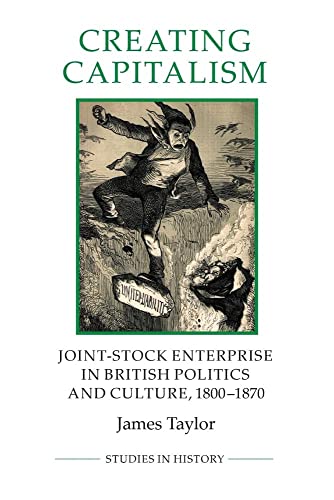
Creating Capitalism by James Taylor
The growth of joint-stock business in Victorian Britain re-evaluated, showing in particular the resistance to it. Winner of the Economic History Society's Best First Monograph award 2009 The emergence of the joint-stock company in nineteenth-century Britain was a culture shock for many Victorians. Though the home of the industrialrevolution, the nation's economy was dominated by the private partnership, seen as the most efficient as well as the most ethical form of business organisation. The large, impersonal company and the rampant speculation it was thought to encourage were viewed with suspicion and downright hostility. This book argues that the existing historiography understates society's resistance to joint-stock enterprise; it employs an eclectic range of sources, fromnewspapers and parliamentary papers to cartoons, novels and plays, to unearth this forgotten economic debate. It explores how the legal system was gradually restructured to facilitate joint-stock enterprise, a process culminatingin the limited liability legislation of the mid-1850s. This has typically been interpreted as evidence for the emergence of new, positive attitudes to speculation and economic growth, but the book demonstrates how traditional outlooks continued to influence legislation, and the way in which economic reforms were driven by political agendas. It shows how debates on the economic culture of nineteenth-century Britain are strikingly relevant to current questions over the ethics of multinational corporations. James Taylor is Senior Lecturer in British History at Lancaster University.
A very interesting, well-argued, and well documented study of the rise of joint-stock enterprise that explores the political and cultural milieu within which legal reforms occurred* NINETEENTH CENTURY STUDIES *
A splendid addition to the Royal Historical Society's series 'Studies in History', which is providing a valuable outlet for some of the best new post-doctoral research in Britain. [...] Anyone reading it cannot fail to be struck by its quality. It should enhance considerably [the author's] reputation as one of the finest historians in the country. * ECONOMIC HISTORY REVIEW *
Makes an important contribution to our understanding of why joint-stock enterprise became such an established element within Britain in the mid-nineteenth century. * . *
[A] well researched and well written book. EH.NET-Review * . *
Taylor breaks with earlier historiography [and] develops his own explanation of events by the bold concept of invading the nineteenth-century imagination. This is achieved with aplomb, through a wise and convincing blend of sources conventionally used by business historians, along with more novel material, notably cultural and literary sources, peppered with a dozen pertinent cartoons reproduced in these pages. * ENTERPRISE AND SOCIETY, *
A splendid addition to the Royal Historical Society's series 'Studies in History', which is providing a valuable outlet for some of the best new post-doctoral research in Britain. [...] Anyone reading it cannot fail to be struck by its quality. It should enhance considerably [the author's] reputation as one of the finest historians in the country. * ECONOMIC HISTORY REVIEW *
Makes an important contribution to our understanding of why joint-stock enterprise became such an established element within Britain in the mid-nineteenth century. * . *
[A] well researched and well written book. EH.NET-Review * . *
Taylor breaks with earlier historiography [and] develops his own explanation of events by the bold concept of invading the nineteenth-century imagination. This is achieved with aplomb, through a wise and convincing blend of sources conventionally used by business historians, along with more novel material, notably cultural and literary sources, peppered with a dozen pertinent cartoons reproduced in these pages. * ENTERPRISE AND SOCIETY, *
James Taylor is the CEO of Decision Management Solutions, and is the leading expert in how to use business rules and analytic technology to build Decision Management Systems. James is passionate about using Decision Management Systems to help companies improve decision-making and develop an agile, analytic, and adaptive business. He has more than 20 years working with clients in all sectors to identify their highest-value opportunities for advanced analytics, enabling them to reduce fraud, continually manage and assess risk, and maximize customer value with increased flexibility and speed. In addition to strategy consulting, James has been a keynote speaker at many events for executive audiences, including ComputerWorld's BI & Analytics Perspectives, Gartner Business Process Management Summit, Information Management Europe, Business Intelligence South Africa, The Business Rules Forum, Predictive Analytics World, IBM's Business Analytics Forum, and IBM's CIO Leadership Exchange. James is also a faculty member of the International Institute for Analytics. In 2007, James wrote Smart (Enough) Systems: How to Deliver Competitive Advantage by Automating Hidden Decisions (Prentice Hall) with Neil Raden, and has contributed chapters on Decision Management to multiple books, including Applying Real-World BPM in an SAP Environment, The Decision Model, The Business Rules Revolution: Doing Business The Right Way, and Business Intelligence Implementation: Issues and Perspectives. He blogs on Decision Management at www.jtonedm.com and has written dozens of articles on Decision Management Systems for CRM Magazine, Information Management, Teradata Magazine, The BPM Institute, BeyeNetwork, InformationWeek, and TDWI's BI Journal. He was previously a Vice President at Fair Isaac Corporation, spent time at a Silicon Valley startup, worked on PeopleSoft's R&D team, and as a consultant with Ernst and Young. He has spent the last 20 years developing approaches, tools, and platforms that others can use to build more effective information systems. He lives in Palo Alto, California with his family. When he is not writing about, speaking on or developing Decision Management Systems, he plays board games, acts as a trustee for a local school, and reads military history or science fiction.
| SKU | Unavailable |
| ISBN 13 | 9780861933235 |
| ISBN 10 | 0861933230 |
| Title | Creating Capitalism |
| Author | James Taylor |
| Series | Royal Historical Society Studies In History New Series |
| Condition | Unavailable |
| Binding Type | Paperback |
| Publisher | Boydell & Brewer Ltd |
| Year published | 2014-05-15 |
| Number of pages | 272 |
| Cover note | Book picture is for illustrative purposes only, actual binding, cover or edition may vary. |
| Note | Unavailable |