
Critical Race Judgments


Critical Race Judgments
Regular price
Checking stock...
Regular price
Checking stock...
Summary
How might seminal Supreme Court cases have come out differently had CRT insights shaped the development of constitutional law? This book answers that question by re-writing opinions that implicate critical dimensions of racial justice, including the death penalty, employment, voting, policing, education, environmental justice, and immigration.
The feel-good place to buy books
- Free US shipping over $15
- Buying preloved emits 41% less CO2 than new
- Millions of affordable books
- Give your books a new home - sell them back to us!
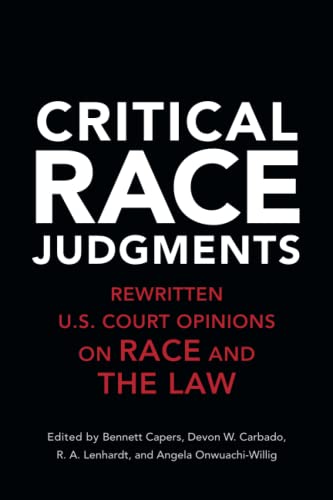
Critical Race Judgments by Bennett Capers
By re-writing US Supreme Court opinions that implicate critical dimensions of racial justice, Critical Race Judgments demonstrates that it's possible to be judge and a critical race theorist. Specific issues covered in these cases include the death penalty, employment, voting, policing, education, the environment, justice, housing, immigration, sexual orientation, segregation, and mass incarceration. While some rewritten cases – Plessy v. Ferguson (which constitutionalized Jim Crow) and Korematsu v. United States (which constitutionalized internment) – originally focused on race, many of the rewritten opinions – Lawrence v. Texas (which constitutionalized sodomy laws) and Roe v. Wade (which constitutionalized a woman's right to choose) – are used to incorporate racial justice principles in novel and important ways. This work is essential for everyone who needs to understand why critical race theory must be deployed in constitutional law to uphold and advance racial justice principles that are foundational to US democracy.
'What a brilliant idea to invite critical race theorists to reimagine some of the most important and impactful legal cases in our historyThe provocative collection shows what might have been if justices and judges employed an equitable lens to cases. It also shows what can still be: a fairer, egalitarian world.' Ibram X. Kendi, author of Stamped from the Beginning and How to Be an Antiracist
'What if the U.S. Supreme Court treated racial inequalities as diagnoses of where American institutions need change rather than as natural, immutable, and fair? At this contentious time, pitting racial reckoning against political backlash—when cynics hijack the phrase 'critical race theory' to terrorize teachers from sharing America's actual history even as corporations embrace 'diversity, equity, and inclusion'—this collection of rigorous chapters accepts constraints of legal reasoning while demonstrating how court decisions could have centered rather than obscured the actual experiences of African Americans, American Indians, Native Hawaiians, Mexican-Americans, and immigrants. Legal treatments of voting, schooling, employment, and policing could all have been different. With telling details across American law and history, this book invigorates future possibilities of justice for all families, communities, and human beings.' Martha Minow, author of In Brown's Wake: Legacies of America's Constitutional Landmark, 300th Anniversary University Professor, Harvard University
'American law is one of the battlegrounds on which the struggle for racial justice has been fought, at times serving as a barrier to justice and at other times pointing the way. The thought-provoking essays in this timely book force us to think about how we got where we are, and to imagine how these seminal decisions could have brought us to an altered, more just present.' Deborah N. Archer, President, ACLU, and Professor of Clinical Law and Co-Faculty Director, Center on Race, Law, and Inequality, NYU Law School
'Critical Race Judgments could not come at more important moment. Each offering from the brilliant array of legal scholars assembled for this extraordinary project compels us to imagine the America that could have been, had the Supreme Court's jurisprudence been informed by the necessary truths that critical race theory engages. Ironically this makes Critical Race Judgments both devastating and inspiring - clearly exposing the ruinous jurisprudential path that has led us away from fulfilling the promise of the Civil War Amendments, and offering a potential path towards a jurisprudence that could still save our fragile republic.' Sherrilyn Ifill, NAACP Legal Defense Fund President and Co-Director
'… useful for undergraduate and graduate students of law and for members of the general public interested in current conversations around the Constitution and critical race theory. … Recommended.' C. Grose, Choice
'What if the U.S. Supreme Court treated racial inequalities as diagnoses of where American institutions need change rather than as natural, immutable, and fair? At this contentious time, pitting racial reckoning against political backlash—when cynics hijack the phrase 'critical race theory' to terrorize teachers from sharing America's actual history even as corporations embrace 'diversity, equity, and inclusion'—this collection of rigorous chapters accepts constraints of legal reasoning while demonstrating how court decisions could have centered rather than obscured the actual experiences of African Americans, American Indians, Native Hawaiians, Mexican-Americans, and immigrants. Legal treatments of voting, schooling, employment, and policing could all have been different. With telling details across American law and history, this book invigorates future possibilities of justice for all families, communities, and human beings.' Martha Minow, author of In Brown's Wake: Legacies of America's Constitutional Landmark, 300th Anniversary University Professor, Harvard University
'American law is one of the battlegrounds on which the struggle for racial justice has been fought, at times serving as a barrier to justice and at other times pointing the way. The thought-provoking essays in this timely book force us to think about how we got where we are, and to imagine how these seminal decisions could have brought us to an altered, more just present.' Deborah N. Archer, President, ACLU, and Professor of Clinical Law and Co-Faculty Director, Center on Race, Law, and Inequality, NYU Law School
'Critical Race Judgments could not come at more important moment. Each offering from the brilliant array of legal scholars assembled for this extraordinary project compels us to imagine the America that could have been, had the Supreme Court's jurisprudence been informed by the necessary truths that critical race theory engages. Ironically this makes Critical Race Judgments both devastating and inspiring - clearly exposing the ruinous jurisprudential path that has led us away from fulfilling the promise of the Civil War Amendments, and offering a potential path towards a jurisprudence that could still save our fragile republic.' Sherrilyn Ifill, NAACP Legal Defense Fund President and Co-Director
'… useful for undergraduate and graduate students of law and for members of the general public interested in current conversations around the Constitution and critical race theory. … Recommended.' C. Grose, Choice
Bennett Capers is a Professor of Law at Fordham Law School and Director of the Center on Race, Law, and Justice. He teaches and writes in the area of criminal law, criminal procedure, evidence, and race. Devon W. Carbado is the Honorable Harry Pregerson Professor of Law at UCLA School of Law and the former Associate Vice Chancellor of BruinX for Equity, Diversity and Inclusion. R. A. Lenhardt is a Professor of Law at Georgetown Law and Co-Founder of the Racial Justice Initiative. Professor Lenhardt specializes in matters pertaining to race, family, and citizenship. Angela Onwuachi-Willig is dean and Ryan Roth Gallo & Ernest J. Gallo Professor of Law at Boston University School of Law. She specializes in matters pertaining in critical race theory, employment discrimination, and family law.
| SKU | Unavailable |
| ISBN 13 | 9781316616451 |
| ISBN 10 | 1316616452 |
| Title | Critical Race Judgments |
| Author | Bennett Capers |
| Condition | Unavailable |
| Binding Type | Paperback |
| Publisher | Cambridge University Press |
| Year published | 2022-04-21 |
| Number of pages | 600 |
| Cover note | Book picture is for illustrative purposes only, actual binding, cover or edition may vary. |
| Note | Unavailable |