


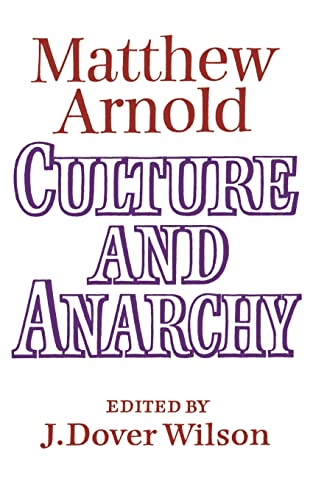
Culture and Anarchy by Matthew Arnold
Manifesting the special intelligence of a literary critic of original gifts, Culture and Anarchy is still a living classic. It is addressed to the flexible and the disinterested, to those who are not committed to the findings of their particular discipline, and it assumes in its reader a critical intelligence that will begin its work with the reader himself. Arnold employs a delicate and stringent irony in an examination of the society of his time: a rapidly expanding industrial society, just beginning to accustom itself to the changes in its institutions that the pace of its own development called for. Coming virtually at the end of the decade (1868) and immediately prior to W. E. Forster's Education Act, Culture and Anarchy phrases with a particular cogency the problems that find their centre in the questions: what kind of life do we think individuals in mass societies should be assisted to lead? How may we best ensure that the quality of their living is not impoverished? Arnold applies himself to the detail of his time: to the case of Mr Smith 'who feared he would come to poverty and be eternally lost', to the Reform agitation, to the commercial values that working people were encouraged to respect, and to the limitations of even the best Rationalist intelligence. The degree of local reference is therefore high, but John Dover Wilson's introduction and notes to this edition supply valuable assistance to a reader fresh to the period.
Matthew Arnold was born in Middlesex in 1822, the son of a headmaster of Rugby public school. He was educated at Winchester, Rugby and Oxford, becoming briefly a Fellow before leaving academia for work and travel followed by being appointed an inspector of schools, a post which informed many of his essays and in which he produced a series of trenchant educational reports championing his ideas on culture, society and education until his retirement in 1886. At the same time, he started publishing poetry in 1849, and produced a range of lyric, elegiac, narrative and dramatic verse over the next decade, of which The Scholar Gypsy and Dover Beach are the best-known items. In 1858 he was appointed to the chair of professor of poetry at Oxford, but published only one more volume of poetry himself, in 1867. He turned his attention instead to essays, first in literary criticism (criticism of vernacular literatures being then a new field) then society, politics and culture, and finally, in the 1870s, theology, though the essays frequently range across these disciplines with few separations. Culture and Anarchy, published in 1869, is considered his greatest single work. Matthew Arnold died in 1888.
| SKU | Unavailable |
| ISBN 13 | 9780521091039 |
| ISBN 10 | 0521091039 |
| Title | Culture and Anarchy |
| Author | Matthew Arnold |
| Condition | Unavailable |
| Binding Type | Paperback |
| Publisher | Cambridge University Press |
| Year published | 1932-01-02 |
| Number of pages | 284 |
| Cover note | Book picture is for illustrative purposes only, actual binding, cover or edition may vary. |
| Note | Unavailable |