


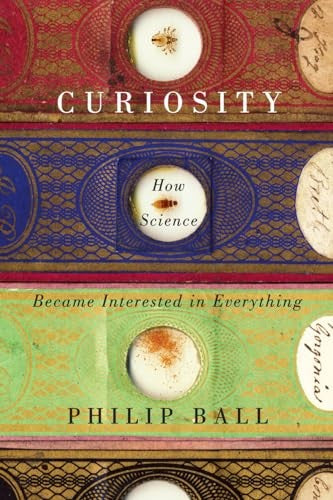
Curiosity by Philip Ball
With the recent landing of the Mars rover Curiosity, it seems safe to assume that the idea of being curious is alive and well in modern science--that it's not merely encouraged but is seen as an essential component of the scientific mission. Yet there was a time when curiosity was condemned. Neither Pandora nor Eve could resist the dangerous allure of unanswered questions, and all knowledge wasn't equal--for millennia it was believed that there were some things we should not try to know. In the late sixteenth century this attitude began to change dramatically, and in Curiosity: How Science Became Interested in Everything, Philip Ball investigates how curiosity first became sanctioned--when it changed from a vice to a virtue and how it became permissible to ask any and every question about the world.
Looking closely at the sixteenth through eighteenth centuries, Ball vividly brings to life the age when modern science began, a time that spans the lives of Galileo and Isaac Newton. In this entertaining and illuminating account of the rise of science as we know it, Ball tells of scientists both legendary and lesser known, from Copernicus and Kepler to Robert Boyle, as well as the inventions and technologies that were inspired by curiosity itself, such as the telescope and the microscope. The so-called Scientific Revolution is often told as a story of great geniuses illuminating the world with flashes of inspiration. But Curiosity reveals a more complex story, in which the liberation--and subsequent taming--of curiosity was linked to magic, religion, literature, travel, trade, and empire. Ball also asks what has become of curiosity today: how it functions in science, how it is spun and packaged for consumption, how well it is being sustained, and how the changing shape of science influences the kinds of questions it may continue to ask.
Though proverbial wisdom tell us that it was through curiosity that our innocence was lost, that has not deterred us. Instead, it has been completely the contrary: today we spend vast sums trying to reconstruct the first instants of creation in particle accelerators, out of a pure desire to know. Ball refuses to let us take this desire for granted, and this book is a perfect homage to such an inquisitive attitude.
Philip Ball is a freelance writer and a consultant editor for Nature, where he previously worked as an editor for physical sciences. He is a regular commentator in the scientific and popular media on science and its interactions with art, history and culture. His ten books on scientific subjects include The Self-Made Tapestry: Pattern Formation in Nature, H2O: A Biography of Water, The Devil's Doctor: Paracelsus and the World of Renaissance Magic and Science, and Critical Mass: How One Thing Leads To Another, which won the 2005 Aventis Prize for Science Books. He was awarded the 2006 James T. Grady - James H. Stack award by the American Chemical Society for interpreting chemistry for the public. Philip studied chemistry at Oxford and holds a doctorate in physics from the University of Bristol. His latest book The Music Instinct published in February 2010.
| SKU | Unavailable |
| ISBN 13 | 9780226045795 |
| ISBN 10 | 022604579X |
| Title | Curiosity |
| Author | Philip Ball |
| Condition | Unavailable |
| Binding Type | Hardback |
| Publisher | The University of Chicago Press |
| Year published | 2013-04-03 |
| Number of pages | 480 |
| Cover note | Book picture is for illustrative purposes only, actual binding, cover or edition may vary. |
| Note | Unavailable |