


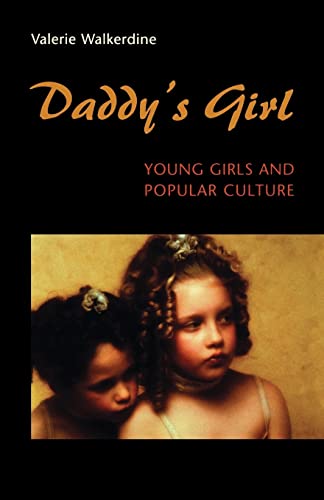
Daddy's Girl by Valerie Walkerdine
When she's itty bitty and blond, wearing ribbons and curls and an aura of money, she's adorable and vulnerable, the tiny, innocent heart of our culture. But when the little girl comes from the working class, she's something else. Just what, and why so little is said about it, are the questions Valerie Walkerdine asks in Daddy's Girl, a book about how we see young girls, how they see themselves, and how popular culture mediates the view. Walkerdine's study looks at little girls on television and in the movies, in advertisements and popular songs. In figures from Annie to Shirley Temple in any number of her plucky poor girl roles, she shows us little orphans saddled with the task of representing the self-sufficient working class on the one hand and the loveable object of middle class charity on the other. The real working class girl, whose fantasies feed on a strange mix of these images and the rest of what popular culture offers, with all its glamorized sex and violence, is also the object of Walkerdine's attention. Reflecting on her own working class roots and taking us into the homes and the confidence of working class girls today as they watch television and movies and listen to popular songs, she gives us a sense, at once troubling and poignant, of the portrayal and manipulation of little girls as a canny part of the production of civilized femininity. At the center of this work is the issue of how girl children are taught to think of themselves and how their depiction puts them in their place. This concern leads Walkerdine to questions about television and parental control, about Freud's seduction theory and the origins of fantasy, about the political and erotic meaning of the ubiquitous gaze our culture trains on the little girl, and about academics' approach to the subject.
Walkderdine's..challenge to certain feminist conceptions of today's problems is both refreshingly iconoclastic and worth considering. She provides a provocative historical analysis of the portrayal of girls in Annie, Lolita, the Shirley Temple movies, My Fair Lady, and Gigi. She also offers her view of the implications of British television programs like Minipops, where young girls, primarily working-class girls, dress up like adult woman rock stars and gyrate provocatively while they sing pop songs full of sexual innuendoes. -- Kathleen Malley-Morrison * Boston Globe *
Well before the Ramsey murder blew [the world of children's beauty contests] open, British psychologist Valerie Walkerdine was researching the effects of popular culture on preteen working-class girls. She presents the results of her research in Daddy's Girl...Obviously, this is timely stuff, but there are other reasons for bringing it to a general audience. Preteen girls have traditionally been overlooked in the world of cultural studies, while teenagers have received a fair amount of attention...Yet if the child-pageant world is anything to go by, interplay between girls and popular culture begins far earlier than adolescence. Looking at girls ages 6 to 10, examining their absorption of popular culture, should then yield important data about our cultural production of femininity. It does...Walkerdine's...research is still probably the deepest, least sensationalist work currently being done in this arena. -- Sarah Coleman * San Francisco Bay Guardian *
Daddy's Girl should act as a springboard for much-needed discussions about the way popular culture influences and reflects both how we view little girls and how they form their own identities...Combining her personal narrative of growing up working-class with studies of icons such as Little Orphan Annie and Shirley Temple and accounts of visits to the homes of working-class families, Walkerdine exposes deep-seated hypocrisies. * Publishers Weekly *
Well before the Ramsey murder blew [the world of children's beauty contests] open, British psychologist Valerie Walkerdine was researching the effects of popular culture on preteen working-class girls. She presents the results of her research in Daddy's Girl...Obviously, this is timely stuff, but there are other reasons for bringing it to a general audience. Preteen girls have traditionally been overlooked in the world of cultural studies, while teenagers have received a fair amount of attention...Yet if the child-pageant world is anything to go by, interplay between girls and popular culture begins far earlier than adolescence. Looking at girls ages 6 to 10, examining their absorption of popular culture, should then yield important data about our cultural production of femininity. It does...Walkerdine's...research is still probably the deepest, least sensationalist work currently being done in this arena. -- Sarah Coleman * San Francisco Bay Guardian *
Daddy's Girl should act as a springboard for much-needed discussions about the way popular culture influences and reflects both how we view little girls and how they form their own identities...Combining her personal narrative of growing up working-class with studies of icons such as Little Orphan Annie and Shirley Temple and accounts of visits to the homes of working-class families, Walkerdine exposes deep-seated hypocrisies. * Publishers Weekly *
Valerie Walkerdine is Foundation Professor of Critical Psychology, University of Western Sydney Nepean.
| SKU | Unavailable |
| ISBN 13 | 9780674186019 |
| ISBN 10 | 067418601X |
| Title | Daddy's Girl |
| Author | Valerie Walkerdine |
| Condition | Unavailable |
| Binding Type | Paperback |
| Publisher | Harvard University Press |
| Year published | 1998-10-15 |
| Number of pages | 192 |
| Cover note | Book picture is for illustrative purposes only, actual binding, cover or edition may vary. |
| Note | Unavailable |