
Dawn Powell: Novels 1930-1942 (LOA #126)


World of Books
The feel-good place to buy books
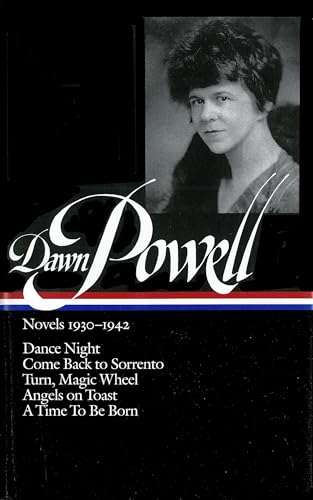
Dawn Powell: Novels 1930-1942 (LOA #126) by Dawn Powell
Dawn Powell--a vital part of literary Greenwich Village from the 1920s through the 1960s--was the tirelessly observant chronicler of two very different worlds: the small-town Ohio where she grew up and the sophisticated Manhattan to which she gravitated. If her Ohio novels are more melancholy and compassionate, her Manhattan novels, exuberant and incisive, sparkle with a cast of writers, show people, businessmen, and hustling hangers-on. All show rich characterization and a flair for the gist of complex social situations. A playful satirist, an unsentimental observer of failed hopes and misguided longings, Dawn Powell is a literary rediscovery of rare importance. In this, one of two volumes collecting nine novels, The Library of America presents the best of Powell's fiction. Dance Night (1930), Powell's own favorite among her works, is a surprisingly frank treatment of obsessive longing set in an Ohio factory town during the 1920s. Come Back to Sorrento (1932; originally published as The Tenth Moon), a compelling study of frustrated aspirations, tells the story of a woman whose friendship with a music teacher awakens her sense of her life's wasted potential. With Turn, Magic, Wheel (1936), a whirlwind tour of Manhattan's literary world, Powell reinvented herself as a satirical writer. Her treatment of the city of perpetual distraction captures the allure of Manhattan with a lightness and wit to be found in all her New York novels. Angels on Toast (1940), whose farcical pace recalls screwball comedy, is a shrewd portrait of the adulterous misadventures of two salesmen. In A Time To Be Born (1942), set during the months before America's entry into World War I, Powell portrays the monstrously egotistical Amanda Keeler Evans--one of her most wickedly barbed creations.
When Dawn Powell died in 1965, virtually all her books were out of print. Not a single historical survey of American literature mentioned her, even in passing. And so she slept, seemingly destined to be forgotten - or, to put it more exactly, never to be remembered. How things have changed! Numerous novels by Dawn Powell are currently available, along with her diaries and short stories. She has joined the Library of America, admitted to the illustrious company of Ralph Waldo Emerson, Henry Adams, Frederick Douglass, and Edith Wharton. She is taught in college and read with delight on vacation. For the contemporary poet and novelist Lisa Zeidner, writing in The New York Times Book Review, Powell is wittier than Dorothy Parker, dissects the rich better than F. Scott Fitzgerald, is more plaintive than Willa Cather in her evocation of the heartland, and has a more supple control of satirical voice than Evelyn Waugh. For his part, Gore Vidal offered a simple reason for Powell's sudden popularity in the early Twentieth Century: We are catching up to her. Dawn Powell was born in Mt. Gilead, Ohio, on November 28, 1896, the second of three daughters. Her father was a traveling salesman, and her mother died a few days after Dawn turned seven. After enduring great cruelty at the hands of her stepmother, Dawn ran away at the age of thirteen and eventually arrived at the home of her maternal aunt, who served hot meals to travelers emerging from the train station across the street. Dawn worked her way through college and made it to New York. There she married a young advertising executive and had one child, a boy who suffered from autism, then an unknown condition. Powell referred to herself as a permanent visitor in her adopted Manhattan and brought to her writing a perspective gained from her upbringing in Middle America. She knew many of the great writers of her time, and Diana Trilling famously said it was Dawn who really says the funny things for which Dorothy Parker gets credit. Ernest Hemingway called her his favorite living writer. She was one of America' s great novelists, and yet when she died in 1965 she was buried in an unmarked grave in New York's Potter's Field.
| SKU | Unavailable |
| ISBN 13 | 9781931082013 |
| ISBN 10 | 1931082014 |
| Title | Dawn Powell: Novels 1930-1942 (LOA #126) |
| Author | Dawn Powell |
| Series | Library Of America Dawn Powell Edition |
| Condition | Unavailable |
| Binding Type | Hardback |
| Publisher | The Library of America |
| Year published | 2001-09-10 |
| Number of pages | 1068 |
| Cover note | Book picture is for illustrative purposes only, actual binding, cover or edition may vary. |
| Note | Unavailable |