


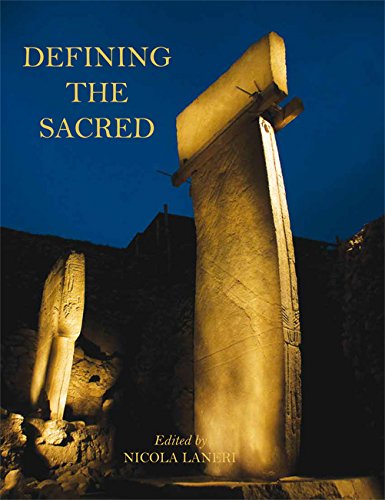
Defining the Sacred by Nicola Laneri
Religion is a phenomenon that is inseparable from human society. It brings about a set of emotional, ideological and practical elements that are pervasive in the social fabric of any society and characterizable by a number of features. these include the establishment of intermediaries in the relationship between humans and the divine; the construction of ceremonial places for worshipping the gods and practicing ritual performances; and the creation ritual paraphernalia. Investigating the religious dimensions of ancient societies encounters problems in defining such elements, especially with regard to societies that lack textual evidences and has tended to lead towards the identification of differentiation between the mental dimension, related to religious beliefs, and the material one associated with religious practices, resulting in a separation between scholars able to investigate, and possibly reconstruct, ritual practices (i.e., archaeologists), and those interested in defining the realm of ancient beliefs (i.e., philologists and religious historians).The aim of this collection of papers is to attempt to bridge these two dimensions by breaking down existing boundaries in order to form a more comprehensive vision of religion among ancient Near Eastern societies. This approach requires that a higher consideration be given to those elements (either artificial -- buildings, objects, texts, etc. -- or natural -- landscapes, animals, trees, etc.) that are created through a materialization of religious beliefs and practices enacted by members of communities. These issues are addressed in a series of specific case-studies covering a broad chronological framework that from the Pre-pottery Neolithic to the Iron Age.
Overall, the Laneri volume will engage those scholars looking for specific case studies addressing their own period- or region-based interests, particularly Near Eastern specialists* Antiquity *
...the approaches presented by the papers are varied and often innovative, sometimes raising as many questions as they answer, and they offer significant insights into the archaeology of religion in the ancient Near East. * American Journal Of Archaeology *
All told, this is a very useful and interesting volume, which collects a diverse group of studies on various cultures, periods and issues, and from, at times, very different perspectives, on the archaeology of religion in the ancient Near East. The editor and the contributors are to be thanked for this important collection. * Bryn Mawr Classical Review *
...the approaches presented by the papers are varied and often innovative, sometimes raising as many questions as they answer, and they offer significant insights into the archaeology of religion in the ancient Near East. * American Journal Of Archaeology *
All told, this is a very useful and interesting volume, which collects a diverse group of studies on various cultures, periods and issues, and from, at times, very different perspectives, on the archaeology of religion in the ancient Near East. The editor and the contributors are to be thanked for this important collection. * Bryn Mawr Classical Review *
Nicola Laneri is Director of the School of Religious Studies at CAMNES/Lorenzo de’ Medici (Florence). He taught Archaeology of the Ancient Near East at the University of Catania, the University of Chicago, the Middle Eastern Technical University of Ankara and the Oriental Institute of Naples. From 2003 until 2016, he has been the director of the Hirbemerdon Tepe Archaeological Project (southeastern Turkey). He has published more than 80 scientific articles in journals and books.
| SKU | Unavailable |
| ISBN 13 | 9781782976790 |
| ISBN 10 | 1782976795 |
| Title | Defining the Sacred |
| Author | Nicola Laneri |
| Condition | Unavailable |
| Binding Type | Paperback |
| Publisher | Oxbow Books |
| Year published | 2015-05-08 |
| Number of pages | 200 |
| Cover note | Book picture is for illustrative purposes only, actual binding, cover or edition may vary. |
| Note | Unavailable |