
The Descent of the Child


World of Books
The feel-good place to buy books
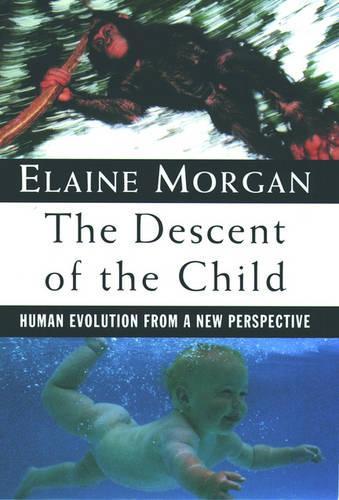
The Descent of the Child by Elaine Morgan
Why are chimp babies skinny, while human babies are so fat they float? As humans developed greater intelligence--and increased cranial capacity--how did babies and mothers adapt to increased fetal brain size? And how did humans develop our unique intelligence. Elaine Morgan, an internationally bestselling science writer known for her iconoclastic take on evolutionary theory, addresses these questions and more in The Descent of the Child, an intriguing and controversial look at human evolution from the point of view of infant development.Beginning with the assertion that much of our thinking about human evolution exercises an unconscious bias--that we envision an archetypal human being as an adult--Morgan sets out to explain why human infants evolved in the way they did. We are often told how, in the course of a million years, adults acquired increased dexterity, adaptability, intelligence, and powers of communication. We are seldom reminded that over the same period infants became more helpless, more vulnerable, and more inert. Morgan focuses on the relationship between these two facts as she develops a stunning theory of the origins of human intelligence she argues that our capacity for intelligence is a byproduct of evolving babyhood. Uniquely among primates, homo sapiens are born with considerable struggle, emerge wholly helpless, and continue to be dependent for a long time afterwards--only their eyes, faces, and vocal cords work. They don't know that they're not always going to be like that, Morgan posits, but, bent on survival, they try to manipulate their parents or other caregivers to do things that the babies can't do for themselves. (For instance, they'll cry for food, and only human babies continue crying after being picked up, sending a strong message not to be so remiss next time.) These early struggles, according to Morgan, provide our formative intellectual activity. It is in infancy that we really learn to think and to question.
In her much debated earlier works, Morgan has championed the controversial Aquatic Ape Theory of human evolution against the widely accepted Savannah Theory. The Descent of the Child takes her further into the fray with a provocative new argument adding new evidence to support AAT even as she explores such urgent topics as conception and infertility, the maturation of the fetus, child rearing and parental roles, overpopulation, and a woman's place in society. This fascinating book should be read by parents (both new and soon to be) as well as anyone interested in child development or human evolution.
Elaine Morgan's first book, The Descent of Woman (1972), was an international bestseller in nine languages. Best known as an award-winning writer for television, she is also the author of The Aquatic Ape (1982).
| SKU | Unavailable |
| ISBN 13 | 9780195098952 |
| ISBN 10 | 0195098951 |
| Title | The Descent of the Child |
| Author | Elaine Morgan |
| Condition | Unavailable |
| Binding Type | Hardback |
| Publisher | Oxford University Press Inc |
| Year published | 1995-04-27 |
| Number of pages | 197 |
| Cover note | Book picture is for illustrative purposes only, actual binding, cover or edition may vary. |
| Note | Unavailable |