


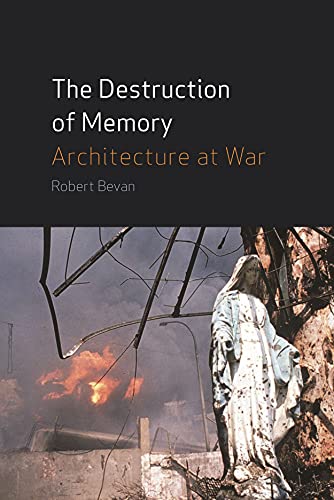
The Destruction of Memory by Robert Bevan
Robert Bevan examines the effects of conflict upon architecture and argues that the deliberate destruction of built artefacts, by terrorists or an invading army, can be seen as an attack on the culture of a nation itself.
As Bevan's fascinating, melancholy book shows, symbolic buildings have long been targeted in and out of war as a particular kind of mnemonic violence against those to whom they are special--Brian Dillon "Guardian" (12/11/2005 12:00:00 AM) Bevan sets down an astonishing litany of barbarism. . . . The most lasting image in this sedulously researched, calmly furious book is that of a Sarajevo librarian, in August 1992, watching the National Library go up in flames. The air was filled with black fragments from priceless volumes: carbonised texts that were legible for a moment in eerie negative, before they turned to dust in his hands.--Brian Dillon "Scotland on Sunday" (12/11/2005 12:00:00 AM) Bevan wisely doesn't push his case to the point of strict consistence; his weighting of the role of architecture in war is not absolutely uniform from case to case, nor does it need to be. . . . It is sobering to have so many apparent facts and figures in one book. . . . Where power belongs to the aggressor, the destruction of one family's home might be taken as the first embodiment of a genocide. In reminding us of this Bevan has performed a valuable service, no matter what we may think about a rebuilt Warsaw or a cherished ruin. . . . If we accept that there is no architecturally embodied identity of a nation or people, that our current historical existence is not vitally wrapped up in relics of an imagined past except as nostalgia, then we are unlikely to worry about the occasionally destruction of buildings. Bevan's book makes clear that such insouciance (and nostalgia) is the privilege of the secure and well-defended nation-states where the continuity of home and shelter is assumed.--David Simpson "London Review of Books" (5/25/2006 12:00:00 AM) Concentrates on the erasure of cultures by the destruction of their buildings and is a must-read.--Diana Muir "RIBA Journal" (4/1/2007 12:00:00 AM) His narrative is compelling and convincing. This important book reveals the extent of cultural warfare, exposes its nature and, by helping us to understand some of the most terrible tragedies of recent times, gives us the means and resolve to fight this evil. All who care must read this book and learn its lessons.--Dan Cruickshank "The Independent" (2/10/2006 12:00:00 AM) His research runs deep, and his visits and interviews are wide-ranging. . . . Instructive.--Reamy Jansen "Bloomsbury Review" (9/1/2006 12:00:00 AM) The idea of a global inheritance seems to have fallen by the wayside and lessons that should have long ago been learned are still being recklessly disregarded. This is what makes Bevan's book relevant, even urgent: much of the destruction of which it speaks is still under way.--Lucy Daniel "Financial Times Magazine" (1/22/2006 12:00:00 AM) The ways in which memory inheres in all parts of the built environment is expressed clearly and this is an absorbing, sobering and scholarly book.--Leslie Sklair "Political Studies Review" (5/1/2007 12:00:00 AM) Thoughtful and provocative. . . .Yet from the Nazi looting of synagogues to the Taliban's demolition of the Bamiyan Buddhas, deliberate destruction of the physical environment has often presaged devastating conflicts. Bevan's timely book urges us to remain attentive to such early warning signs.--Joshua Arthur "In These Times" (7/7/2006 12:00:00 AM) The sheer volume and scope of the material Bevan has gathered on the destruction of architectural heritage as a form of 'cultural cleansing' makes The Destruction of Memory a valuable resource. . . . The mass of absolutely fascinating, morally complex, and, to me at least, often unfamiliar material . . . makes Bevan well worth reading. . . . And yet the book is worth reading, because Bevan uses vivid narrative detail to bring ot our attention the important insight that 'the destruction of the cultural artifacts of an enemy people or nation' can be a kind of analog to genocide or ethnic cleansing.--Diana Muir "History News Network" (5/14/2007 12:00:00 AM) The message of Robert Bevan's devastating book is that war is about killing cultures, identities and memories as much as it is about killing people and occupying territory. War is not just licensed murder but licensed vandalism. Since people are replaceable but buildings and cultures not, the destruction of buildings is often the more ferocious.--Simon Jenkins "The Sunday Times (UK)" (2/26/2005 12:00:00 AM) The Destruction of Memory presents a dark account of how that devastation is brought about, along with a cogent argument for why it deserves recognition as an atrocity separate from the human carnage it so often accompanies. . . . Bevan's grim statistics force readers to confront yet another dimension of the savagery of our age.--Tom Lewis "Wilson Quarterly" (4/1/2006 12:00:00 AM)
Robert Bevan is a journalist, author and heritage-led regeneration consultant. He is an architecture critic for national newspapers in the UK and writes for publications internationally.
| SKU | Unavailable |
| ISBN 13 | 9781861892058 |
| ISBN 10 | 1861892055 |
| Title | The Destruction of Memory |
| Author | Robert Bevan |
| Condition | Unavailable |
| Binding Type | Hardback |
| Publisher | Reaktion Books |
| Year published | 2005-11-01 |
| Number of pages | 240 |
| Cover note | Book picture is for illustrative purposes only, actual binding, cover or edition may vary. |
| Note | Unavailable |