


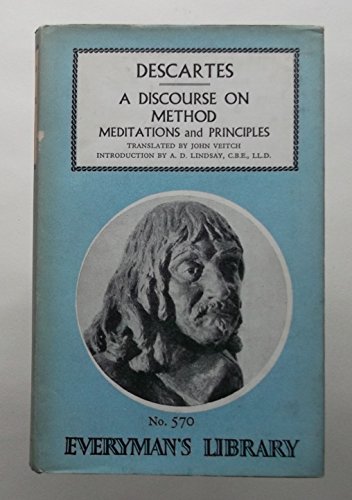
Discourse on Method by Rene Descartes
Descartes is universally acknowledged as the father of modern Western philosophy. It is to the writings of Descartes, above all others that we must turn if we wish to understand the great seventeenth-century revolution in which the old scholastic worldview slowly lost its grip, and the foundations of modern philosophical and scientific thinking were laid. The range of Descartes thought was enormous, and his published work includes writings on mathematics, physics, astronomy, meteorology, optics, physiology, psychology, metaphysics and ethics. A Discourse On Method was written in 1637 for the general public as well as for academics. This work provides a sketch of Descartes' method of philosophical inquiry and also of his general philosophical system: metaphysical, physical, physiological, and moral.
RENE DESCARTES was born into a family of some means in the small French town of La Haye on March 31, 1596. With the death of his mother when Descartes was barely one year old, he was raised by grandparents until the age of ten when he entered the Jesuit school at La Fleche. At eighteen, Descartes enrolled in the University of Poitiers, where he earned a degree in law. Not long thereafter, while Descartes was serving in the military in the Netherlands he became acquainted with a mathematician and physicist by the name of Isaac Beeckman, who sparked his intellectual interest. A family legacy permitted Descartes to pursue these interests in relative comfort. From 1619 to 1628, Descartes lived in Paris, but spent a good bit of time traveling throughout Europe. It was during this time that he focused his attention on formulating a rational method that could free scientific think-ing and philosophical discourse from the rampant skepticism that threatened to drown discussion of important metaphysical and epistemological questions in a sea of uncertainty. Descartes developed a method that he believed could serve the needs of science and philosophy equally well. His efforts to realize this goal have earned him the title of the father of modern philosophy. In 1628, his travels ended, Descartes settled in the Netherlands, where he remained for the next twenty years. The last few months of his life were spent in Sweden, where he ventured in 1649 at the request of Queen Christina to instruct her in philosophy and to assist in the development of an institute for the advancement of science. While in Stockholm, Descartes came to the aid of the French ambassador, a friend who was suffering from pneumonia. Not long thereafter, Descartes contracted the disease and died on February 11, 1650. Rene Descartes's works include: The World (1633), Essais (1637), Discourse on Method (1637), Meditations Concerning Primary Philosophy (1644), Treatise on the Passions (1648), and Rules for the Direction of the Mind (published posthumously in 1701).
| SKU | Unavailable |
| ISBN 13 | 9780460155700 |
| ISBN 10 | 0460155709 |
| Title | Discourse on Method |
| Author | Rene Descartes |
| Series | Everyman Classics |
| Condition | Unavailable |
| Binding Type | Paperback |
| Publisher | Littlehampton Book Services Ltd |
| Year published | 1987-08-01 |
| Number of pages | 288 |
| Cover note | Book picture is for illustrative purposes only, actual binding, cover or edition may vary. |
| Note | Unavailable |