
Discourse on Method: with Meditations


World of Books
The feel-good place to buy books
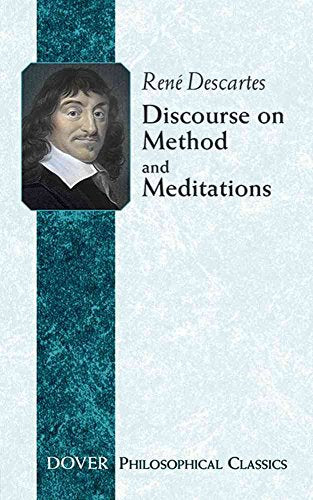
Discourse on Method: with Meditations by G R T Ross
Is it possible to be certain of anything? If so, how? The father of modern philosophy and the founder of rational method in philosophical thought, René Descartes (1596-1650) sought the answers to these questions and in doing so, addressed the most important of methods of thinking and understanding truth. In Discourse on Method, he applies a scientific approach to philosophy that comprises four principles: to accept only what reason recognizes as "clear and distinct"; to analyze complex ideas by dividing them into smaller elements; to reconstruct the ideas; and to make accurate and complete enumerations of the data. His Meditations proceed according to this method, exploring the mind/body distinction, the nature of truth and error, the existence of God, and the essence of material things.
Descartes, Renü¾Ž–”¼: - Renü¾Ž–”¼ Descartes ( 31 March 1596 - 11 February 1650) was a French philosopher, mathematician, and scientist. A native of the Kingdom of France, he spent about 20 years (1629-1649) of his life in the Dutch Republic after serving for a while in the Dutch States Army of Maurice of Nassau, Prince of Orange and the Stadtholder of the United Provinces. One of the most notable intellectual figures of the Dutch Golden Age, [20] Descartes is also widely regarded as one of the founders of modern philosophy. Many elements of Descartes' philosophy have precedents in late Aristotelianism, the revived Stoicism of the 16th century, or in earlier philosophers like Augustine. In his natural philosophy, he differed from the schools on two major points: first, he rejected the splitting of corporeal substance into matter and form; second, he rejected any appeal to final ends, divine or natural, in explaining natural phenomena.[21] In his theology, he insists on the absolute freedom of God's act of creation. Refusing to accept the authority of previous philosophers, Descartes frequently set his views apart from the philosophers who preceded him. In the opening section of the Passions of the Soul, an early modern treatise on emotions, Descartes goes so far as to assert that he will write on this topic as if no one had written on these matters before. His best known philosophical statement is I think, therefore I am (French: Je pense, donc je suis; Latin: cogito, ergo sum), found in Discourse on the Method (1637; written in French and Latin) and Principles of Philosophy (1644; written in Latin).[22] Descartes laid the foundation for 17th-century continental rationalism, later advocated by Spinoza and Leibniz, and was later opposed by the empiricist school of thought consisting of Hobbes, Locke, Berkeley, and Hume. Leibniz, Spinoza, [23] and Descartes were all well-versed in mathematics as well as philosophy, and Descartes and Leibniz contributed greatly to science as well.[24] Descartes' Meditations on First Philosophy (1641) continues to be a standard text at most university philosophy departments. Descartes' influence in mathematics is equally apparent; the Cartesian coordinate system was named after him. He is credited as the father of analytical geometry, the bridge between algebra and geometry-used in the discovery of infinitesimal calculus and analysis. Descartes was also one of the key figures in the Scientific Revolution.
| SKU | Unavailable |
| ISBN 13 | 9780486432526 |
| ISBN 10 | 0486432521 |
| Title | Discourse on Method: with Meditations |
| Author | G R T Ross |
| Series | Dover Philosophical Classics |
| Condition | Unavailable |
| Binding Type | Paperback |
| Publisher | Dover Publications Inc. |
| Year published | 2004-02-27 |
| Number of pages | 128 |
| Cover note | Book picture is for illustrative purposes only, actual binding, cover or edition may vary. |
| Note | Unavailable |