


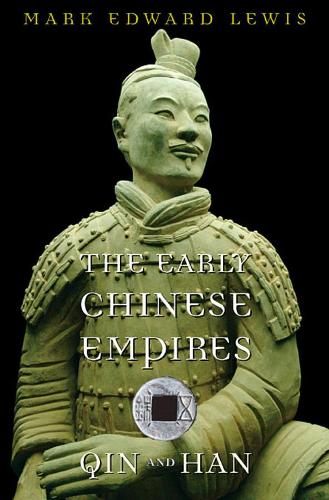
The Early Chinese Empires by Mark Edward Lewis
In 221 BC the First Emperor of Qin unified what would become the heart of a Chinese empire whose major features would endure for two millennia. In the first of a six-volume series on the history of imperial China, Lewis highlights the key challenges facing court officials and scholars who set about governing an empire of such scale and diversity.
Mark Lewis’s mind-opening and readable book reminds us of the enduring but changing realities of China-- Jonathan Mirsky * Times Literary Supplement *
The Early Chinese Empires is a brilliant example of nuanced, responsible popularization. As the first in a series of six volumes that will cover all of Imperial China, it sets a very high standard. -- Grant Hardy * The Historian *
Inaugurating a six-volume series on the history of imperial China, this volume holds that characteristics of the first Chinese empire broadly endured for the succeeding 2,000 years… [Those] planning to acquire the entire series mustn’t omit Lewis’s solid foundation. -- Gilbert Taylor * Booklist *
The standard multivolume history of China has long been the magisterial, exhaustive Cambridge History of China. Now Harvard University Press has announced a six-volume series that will cover the rise, development, and decline of dynastic China from the second century B.C.E. through the early 20th century in an up-to-date, compact, and approachable way. This opening volume by Lewis foretells that the series will become the new gold standard, as the author explains in clear and telling detail how the Qin dynasty ruthlessly defeated a succession of rivals to unify briefly what we now call China in 221 B.C.E. We then see how the succeeding Han dynasty (206 B.C.E.–220 C.E.) combined social engineering and political savvy to institutionalize control and form a ‘classical’ era parallel to the Greeks and Romans in the West. Han imperial structures, including religion, literature, and law, were quite different from what evolved out of them, but Lewis convincingly argues that later societies cannot be understood without understanding this classical foundation. -- Charles W. Hayford * Library Journal (starred review) *
As the first volume in the History of Imperial China, The Early Chinese Empires sets an authoritative, reliable tone that bodes well for this important new series. The book meets a high standard of historical accuracy and covers an impressively broad range of topics. Accessible to a wide audience, it will appeal to anyone interested in the foundations of the Chinese imperial tradition. -- Victor H. Mair, University of Pennsylvania
This series on China, brilliantly overseen by Timothy Brook, is a credit to Harvard University Press. Above all, it encourages us to think of China in different ways. -- Jonathan Mirsky * Literary Review *
The Early Chinese Empires is a brilliant example of nuanced, responsible popularization. As the first in a series of six volumes that will cover all of Imperial China, it sets a very high standard. -- Grant Hardy * The Historian *
Inaugurating a six-volume series on the history of imperial China, this volume holds that characteristics of the first Chinese empire broadly endured for the succeeding 2,000 years… [Those] planning to acquire the entire series mustn’t omit Lewis’s solid foundation. -- Gilbert Taylor * Booklist *
The standard multivolume history of China has long been the magisterial, exhaustive Cambridge History of China. Now Harvard University Press has announced a six-volume series that will cover the rise, development, and decline of dynastic China from the second century B.C.E. through the early 20th century in an up-to-date, compact, and approachable way. This opening volume by Lewis foretells that the series will become the new gold standard, as the author explains in clear and telling detail how the Qin dynasty ruthlessly defeated a succession of rivals to unify briefly what we now call China in 221 B.C.E. We then see how the succeeding Han dynasty (206 B.C.E.–220 C.E.) combined social engineering and political savvy to institutionalize control and form a ‘classical’ era parallel to the Greeks and Romans in the West. Han imperial structures, including religion, literature, and law, were quite different from what evolved out of them, but Lewis convincingly argues that later societies cannot be understood without understanding this classical foundation. -- Charles W. Hayford * Library Journal (starred review) *
As the first volume in the History of Imperial China, The Early Chinese Empires sets an authoritative, reliable tone that bodes well for this important new series. The book meets a high standard of historical accuracy and covers an impressively broad range of topics. Accessible to a wide audience, it will appeal to anyone interested in the foundations of the Chinese imperial tradition. -- Victor H. Mair, University of Pennsylvania
This series on China, brilliantly overseen by Timothy Brook, is a credit to Harvard University Press. Above all, it encourages us to think of China in different ways. -- Jonathan Mirsky * Literary Review *
Mark Edward Lewis is Kwoh-Ting Li Professor in Chinese Culture at Stanford University. Timothy Brook is Professor of History and Republic of China Chair at the University of British Columbia.
| SKU | Unavailable |
| ISBN 13 | 9780674057340 |
| ISBN 10 | 0674057341 |
| Title | The Early Chinese Empires |
| Author | Mark Edward Lewis |
| Series | History Of Imperial China |
| Condition | Unavailable |
| Binding Type | Paperback |
| Publisher | Harvard University Press |
| Year published | 2010-10-30 |
| Number of pages | 336 |
| Prizes | Nominated for John K. Fairbank Prize in East Asian History 2007, Nominated for Joseph Levenson Book Prize 2009 |
| Cover note | Book picture is for illustrative purposes only, actual binding, cover or edition may vary. |
| Note | Unavailable |