
The Economic Consequences of the Euro


Summary
The feel-good place to buy books
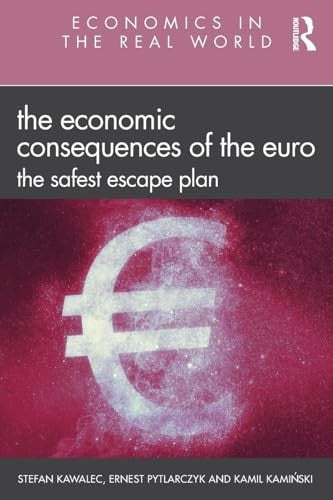
The Economic Consequences of the Euro by Ernest Pytlarczyk
In order to save the European Union and the common market, the book proposes an orderly dismantling of the eurozone, and the creation of a new European currency coordination system. The authors make the case that the optimal solution would be to start the process with the most competitive countries exiting the Eurozone first."The authors cast clear and revealing light on the painful dilemmas posed by the single currency for the countries that use itTheir book builds on previous contributions to this debate by showing not only why the Euro is unsustainable but also, and more fundamentally, how the Euro should be dismantled. In one of their more striking arguments, the authors draw a parallel between the constraints imposed on present-day European economies by the Euro and the effects of the gold standard in the interwar period, highlighting the dangers of such an exchange rate regime for European democracies. This book contains a powerful warning about real dangers and constructive proposals for avoiding them." — Brigitte Granville, Professor of International Economics and Economic Policy at Queen Mary University of London
"This book is a sensation for three reasons:
First, it demonstrates how detrimental the euro is to Europe and the EU. Stefan Kawalec, Ernest Pytlarczyk and Kamil Kamiński deal with this subject without the usual ideological background music.□
Secondly, like a medical team, they not only provide a diagnosis and a prognosis (for what will happen if nothing is being done about it), they prescribe a medicine, the patient being the Eurozone. These authors come up with what is by far the most realistic and the least disruptive way out of the Eurozone.
Thirdly, the book has been written by distinguished highly competent economists, from a country which is not a member of the Eurozone. This book will surely help avoid the Poles losing their monetary and economic independence by making the same mistake as the Austrians, the Germans and the Dutch did. But most importantly the book may help existing Eurozone members and the whole EU to exit the euro trap. That’s why this book should be widely circulated in all EU countries. It is not the first time, Poles teach Western Europeans a lesson in freedom." — Hans-Olaf Henkel, Former President of the Federation of German Industry – BDI (1995–2000). Former President of the Leibniz Association and former CEO of IBM Europe
"This book should be required reading for European economic policymakers wishing to avoid another lost European economic decade. In a highly readable and timely manner, it provides a well-researched and insightful diagnosis of the Eurozone’s economic malaise. More welcome yet, it provides a thought provoking and persuasive plan for Europe to exit its Euro trap. European policymakers would ignore this book’s constructive exchange system proposals at their peril." — Desmond Lachman, Resident fellow at the American Enterprise Institute. Former deputy director in the International Monetary Fund’s Policy Development and Review Department
"In distinguishing between productivity and competitiveness the authors have provided a very rigorous analysis of the role of currency adjustments in modern history, and of why the existence of the euro will make it nearly impossible for European economies to adjust without incurring severe social and political costs. This is an important book that should be read by any European policymaker or citizen interested in the role of the euro in domestic and EU-wide policymaking." — Michael Pettis, Senior Fellow at Carnegie-Tsinghua Center. Professor of Finance and Economics at Peking University
"Building on their work on Controlled Dismantlement of the Eurozone, published in 2013 in the German Economic Review, the authors explore the consequences of an unpleasant truth that is increasingly hard to conceal: the Eurozone is not an optimal currency area, and there is no such thing as an ‘endogenous optimum currency area’. The long-run consequences of real exchange rate misalignment on productivity growth, an obvious consequence of preventing nominal exchange rate adjustment, are putting European countries on diverging trajectories. It is now up to contemporary politicians to understand that the economic unsustainability of the single currency cannot and should not be addressed through politically unsustainable measures (ranging from restricting freedom of speech on these issues to addressing imbalances through austerity policies). Kawalec, Pytlarczyk and Kamiński's book provides a way out of this trap: dismantling the Eurozone starting from the more competitive countries. Far from being a mere provocation, this proposal should be considered seriously by European governments as a precious opportunity to manage an unavoidable outcome." — Sen. Alberto Bagnai, Associate Professor of Economic Policy, Head of the Treasury and Finance Committee, Senate of the Italian Republic
Stefan Kawalec is the CEO of Capital Strategy, a strategy consulting company in Poland, and a co-founder of the European Solidarity Manifesto.
Ernest Pytlarczyk is the chief economist at mBank S.A., one of the biggest commercial banks in Poland and a subsidiary of Germany’s Commerzbank.
Kamil Kamiński is an advisor to the CEO of PKO Bank Polski S.A., Poland’s biggest commercial bank.
| SKU | Unavailable |
| ISBN 13 | 9780367149369 |
| ISBN 10 | 0367149362 |
| Title | The Economic Consequences of the Euro |
| Author | Ernest Pytlarczyk |
| Series | Economics In The Real World |
| Condition | Unavailable |
| Binding Type | Paperback |
| Publisher | Taylor & Francis Ltd |
| Year published | 2019-12-13 |
| Number of pages | 212 |
| Cover note | Book picture is for illustrative purposes only, actual binding, cover or edition may vary. |
| Note | Unavailable |