
Economic Integration of the Korean Peninsula


World of Books
The feel-good place to buy books
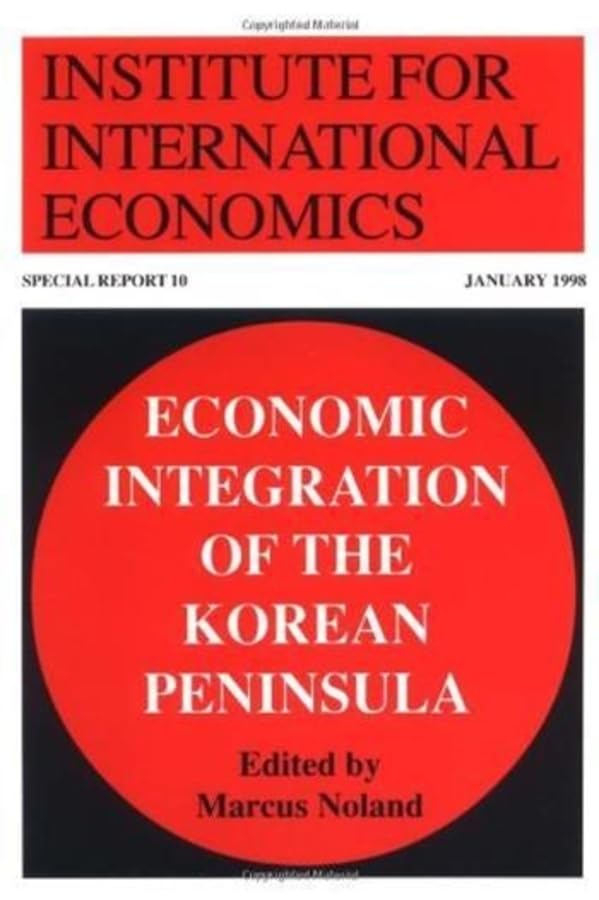
Economic Integration of the Korean Peninsula by Marcus Noland
The North Korean economy cannot sustain its population. Absent fundamental economic reforms, it will never be able to do so. Hence North Korea will require sizable external support for the foreseeable future. South Korea, China, Japan, and the United States have been willing to provide this support because they fear a collapse in the North or, even worse, a lashing out that would unleash war on the peninsula and put millions of people in Asia in jeopardy--including thousands of US troops stationed in South Korea and Japan. The status quo is thus closer to extortion than charity. In this volume, a diverse group of contributors analyze prospective developments on the Korean peninsula. The authors first address the three broad strategic possibilities of war, collapse, and gradual adjustment. Four immediate policy issues are then considered: the current economic conditions and policies in the North, the food crisis, the nuclear energy/nuclear weapons issue, and the possibility of large-scale refugee flows. Finally, the volume considers several longer-run issues concerning the inevitable integration of the peninsula: the potential relevance of the German experience, the costs and benefits of economic unification between North and South Korea, and the possible role of the international financial institutions in funding the new arrangement. The volume concludes with recommendations for policymakers, especially in the United States and South Korea, from the preceding analyses.
Marcus Noland, executive vice president and director of studies, has been associated with the Institute since 1985. From 2009 through 2012, he served as the Institute's deputy director. His research addresses a wide range of topics at the interstice of economics, political science, and international relations. His areas of geographical knowledge and interest include Asia and Africa where he has lived and worked, and the Middle East. In the past he has written extensively on the economies of Japan, Korea, and China, and is unique among American economists in having devoted serious scholarly effort to the problems of North Korea and the prospects for Korean unification. He won the 2000-01 Ohira Memorial Award for his book Avoiding the Apocalypse: The Future of the Two Koreas. Howard Pack has been a professor of business and public policy and professor of economics at the Wharton School (University of Pennsylvania) since 1986. He has been a professor of management there since 1995 and was the professor of city and regional planning (1986-94). He has also taught at Swarthmore College and Yale University. He has served as a consultant for a host of World Bank projects over the past three decades and has been an adviser to the Bank's Global Development Network since 1999. He is the author or coauthor of Industrial Policy in an Era of Globalization: Lessons from Asia (2003), Productivity, Technology and Industrial Development (Oxford University Press, 1987) and Structural Change and Economic Policy in Israel (Yale University Press, 1971).
| SKU | Unavailable |
| ISBN 13 | 9780881322552 |
| ISBN 10 | 0881322555 |
| Title | Economic Integration of the Korean Peninsula |
| Author | Marcus Noland |
| Condition | Unavailable |
| Binding Type | Paperback |
| Publisher | The Peterson Institute for International Economics |
| Year published | 1998-01-01 |
| Number of pages | 290 |
| Cover note | Book picture is for illustrative purposes only, actual binding, cover or edition may vary. |
| Note | Unavailable |