
Economy, Society, and Public Policy


World of Books
The feel-good place to buy books
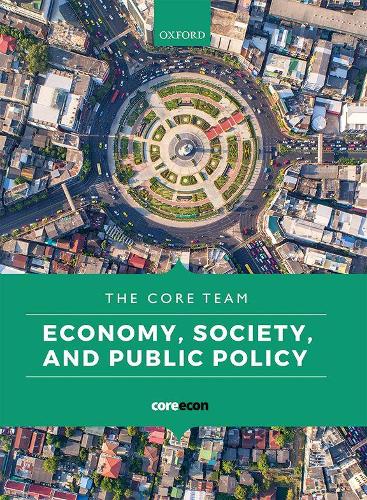
Economy, Society, and Public Policy by Core Team
In order to be well-governed, a democracy needs voters who are fluent in the language of economics and who can do some quantitative analysis of social and economic policy. We also need a well-trained cadre of researchers and journalists who have more advanced skills in these fields. Many students in other disciplines are drawn to economics so that they can engage with policy debates on environmental sustainability, inequality, the future of work, financial instability, and innovation. But, when they begin the study of economics, they find that courses appear to have little to do with these pressing policy matters, and are designed primarily for students who want to study the subject as their major, or even for those destined to go on to post-graduate study in the field. The result: policy-oriented students often find they have to choose between a quantitative and analytical course of studyeconomicsthat is only minimally policy oriented in content and that downplays the insights of other disciplines, or a policy and problem-oriented course of study that gives them little training in modelling or quantitative scientific methods. Economy, Society, and Public Policy changes this. ills in It has been created specifically for students from social science, public policy, business studies, engineering, biology, and other disciplines who are not economics majors. If you are one of these students, we want to engage, challenge, and empower you with an understanding of economics. We hope you will acquire the tools to articulate reasoned views on pressing policy problems. You may even decide to take more courses in economics as a result. The book is also being used successfully in courses for economics, business, and public policy majors, as well as in economics modules for masters courses in Public Policy and in Philosophy, Politics and Economics (PPE). This textbook - the print complement to CORE's open-access online eBook - is the result of a worldwide collaboration among researchers, educators, and students who are committed to bringing the socially relevant insights of economics to a broader audience.
We chose ESPP because we have a very diverse cohort some students with Economic and Maths A level whilst others do not, so teaching a traditional course was hard most students were bored whilst others were struggling to keep paceWe wanted a more up-to-date, data-driven syllabus that covered the topics students wanted to discuss (inequality, climate change, etc.). I have just have finished teaching the first cohort of nearly 500 students and they seem to be highly engaged. * Carlos Cortinhas, University of Exeter, UK *
ESPP was a very successful text for non-Economics majors. They really appreciated how they could get a great introduction to economics that focused on the real world and data, and was meaningful to their own experience of the world. * Mark Dodd, University of Adelaide, Australia *
Other economics textbooks teach you about individual tools. ESPP, on the other hand, teaches you how to address complex issues such as inequality and unemployment by simultaneously using all the tools in the toolbox. As a public policy student, this approach allowed me to evaluate current events and policy proposals through an economically comprehensive, rather than fragmented, lens. * Alaina Leggette, MPA student at Columbia University (SIPA) *
ESPP is an outstanding resource for teaching economic principles to students who will not major in the field. It provides an accessible yet comprehensive introduction to the economic ideas that are essential for understanding politics and policy. * Matthew DiGiuseppe, Leiden University, Netherlands *
I would recommend ESPP as an excellent resource for a wide range of courses teaching introductory economics with a focus on public policy. It takes some of the key material from The Economy and re-packages it for students who are not specialising in economics, and who want to see the subject in a wider context. I appreciate the increased focus on data, with links to Doing Economics. * Stephen Wright, Birkbeck, University of London, UK *
We were warned by the course leader before the start that we would not see the world in the same way after studying the module and this proved to be the case. While tackling the deep issues of global inequality and market failures CORE also gave us quick insights into specialist areas and analytical tools so I was able in the exam to solve a pure strategy Nash equilibrium and answer questions on the use of monetary policy and explain models of welfare economics. I particularly liked the snapshots of great economics thinkers and interactive graphics which brought complex ideas to life. The course succeeded in refreshing and updating my thinking and gave me confidence to work in more depth within the economics field as a financial journalist.
The dynamic approach makes a sound rejoinder to the critics of the subject as the "dismal science" and its teaching which shows exactly how it is as relevant today as it was during the formative years of Adam Smith or the crisis years of Keynes. * Simon Greaves, FT.com and Student in MSc PPE, Birkbeck, University of London *
ESPP was a very successful text for non-Economics majors. They really appreciated how they could get a great introduction to economics that focused on the real world and data, and was meaningful to their own experience of the world. * Mark Dodd, University of Adelaide, Australia *
Other economics textbooks teach you about individual tools. ESPP, on the other hand, teaches you how to address complex issues such as inequality and unemployment by simultaneously using all the tools in the toolbox. As a public policy student, this approach allowed me to evaluate current events and policy proposals through an economically comprehensive, rather than fragmented, lens. * Alaina Leggette, MPA student at Columbia University (SIPA) *
ESPP is an outstanding resource for teaching economic principles to students who will not major in the field. It provides an accessible yet comprehensive introduction to the economic ideas that are essential for understanding politics and policy. * Matthew DiGiuseppe, Leiden University, Netherlands *
I would recommend ESPP as an excellent resource for a wide range of courses teaching introductory economics with a focus on public policy. It takes some of the key material from The Economy and re-packages it for students who are not specialising in economics, and who want to see the subject in a wider context. I appreciate the increased focus on data, with links to Doing Economics. * Stephen Wright, Birkbeck, University of London, UK *
We were warned by the course leader before the start that we would not see the world in the same way after studying the module and this proved to be the case. While tackling the deep issues of global inequality and market failures CORE also gave us quick insights into specialist areas and analytical tools so I was able in the exam to solve a pure strategy Nash equilibrium and answer questions on the use of monetary policy and explain models of welfare economics. I particularly liked the snapshots of great economics thinkers and interactive graphics which brought complex ideas to life. The course succeeded in refreshing and updating my thinking and gave me confidence to work in more depth within the economics field as a financial journalist.
The dynamic approach makes a sound rejoinder to the critics of the subject as the "dismal science" and its teaching which shows exactly how it is as relevant today as it was during the formative years of Adam Smith or the crisis years of Keynes. * Simon Greaves, FT.com and Student in MSc PPE, Birkbeck, University of London *
Contributors: Gani Aldashev Universite libre de Bruxelles Peter Backus University of Manchester Lucy Barnes University College London Ralf Becker University of Manchester Alvin Birdi University of Bristol Clemens Blab University College London Sue Bloomfield Texas A&M University Antonio Cabrales University College London Wing Chan University College London Institute of Education Carlos Cortinhas University of Exeter Manuela dal Borgo University of Cambridge Marion Dumas London School of Economics Stefano Falcone Universite libre de Bruxelles Florencia Gabriele Emmanuel College Boston Stefan Gitman University College London Arthur Grimes Victoria University of Wellington Marco Gundermann Northampton University David Hope King's College London Girol Karacaoglu Victoria University of Wellington Dunli Li University College London Deborah Mabbett Birkbeck University of London Davide Melcangi University College London Gordon Menzies University of Technology Sydney, UTS Helen Miller Institute for Fiscal Studies Jennifer Miller University of Southern California Michael Muthukrishna London School of Economics Adam Nadzri University College London Antonio Neto University of Porto Gyorgy Ruzicska University College London Paul Segal King's College London Margaret Stevens University of Oxford Guglielmo Volpe Queen Mary University of London Steven Wright Birkbeck University of London Oliver Yimeng Zhang University College London
| SKU | Unavailable |
| ISBN 13 | 9780198849841 |
| ISBN 10 | 0198849842 |
| Title | Economy, Society, and Public Policy |
| Author | Core Team |
| Condition | Unavailable |
| Binding Type | Paperback |
| Publisher | Oxford University Press |
| Year published | 2019-09-18 |
| Number of pages | 632 |
| Cover note | Book picture is for illustrative purposes only, actual binding, cover or edition may vary. |
| Note | Unavailable |