


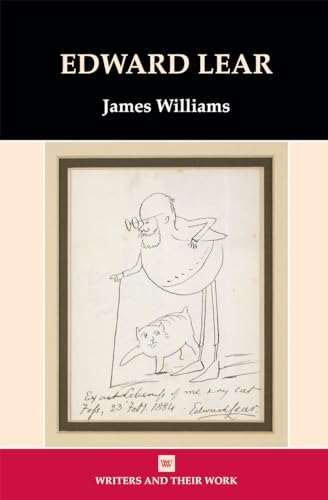
Edward Lear by James Williams
Edward Lear wrote a well-known autobiographical poem that begins 'How pleasant to know Mr Lear!' But how well do we really know him? On the one hand he is, in John Ashbery's words, 'one of the most popular poets who ever lived'; on the other hand he has often been overlooked or marginalized by scholars and in literary histories. James Williams's account, the first book-length critical study of the poet since the 1980s, sets out to re-introduce Lear and to accord him his proper place: as a major Victorian figure of continuing appeal and relevance, and especially as a poet of beauty, comedy, and profound ingenuity. Williams approaches Lear's work thematically, tracing some of its most fundamental subjects and situations. Grounded in attentive close readings, Williams also connects Lear's nonsense with his various other creative endeavours: as a zoological illustrator and landscape painter, a travel writer, and a prolific diarist and correspondent.
'A treat – scholarly, incisive and moving, with brilliantly surprising readings of Lear's work'
Jenny Uglow, author of Mr Lear: A Life of Art and Nonsense
'A wonderfully engaging and revealing book, one that talks a great deal of sense about nonsense (without talking too much sense). The imaginative incisiveness of Williams's reading – and the deftness of his writing – make this the best study of Lear's poetry we have.'
Matthew Bevis, University of Oxford
'This is a study whose significance for the field belies its physical size, standing not only as the best account of Lear’s poetry yet published, but as a work which ought to reorient our sense of Lear’s place in the history of nineteenth-century poetry. […] Williams’s patient explication of the truth it speaks about both sense and nonsense should be regarded as a foundational articulation of Lear’s poetic achievement.'
Benjamin Westwood, The Review of English Studies
Jenny Uglow, author of Mr Lear: A Life of Art and Nonsense
'A wonderfully engaging and revealing book, one that talks a great deal of sense about nonsense (without talking too much sense). The imaginative incisiveness of Williams's reading – and the deftness of his writing – make this the best study of Lear's poetry we have.'
Matthew Bevis, University of Oxford
'This is a study whose significance for the field belies its physical size, standing not only as the best account of Lear’s poetry yet published, but as a work which ought to reorient our sense of Lear’s place in the history of nineteenth-century poetry. […] Williams’s patient explication of the truth it speaks about both sense and nonsense should be regarded as a foundational articulation of Lear’s poetic achievement.'
Benjamin Westwood, The Review of English Studies
James Williams is a Lecturer in English Literature at the University of York. He is the co-editor, with Matthew Bevis, of Edward Lear and the Play of Poetry (OUP, 2016) and, with Anna Barton, of the forthcoming Edinburgh Companion to Nonsense. His publications include essays on Lewis Carroll, Edward Lear, Alfred Tennyson, Samuel Beckett, and Victorian comic verse, as well as the introduction and historical notes to Alice Goodman, History is Our Mother: Three Libretti (NYRB, 2017).
| SKU | Unavailable |
| ISBN 13 | 9780746312223 |
| ISBN 10 | 0746312229 |
| Title | Edward Lear |
| Author | James Williams |
| Series | Writers And Their Work |
| Condition | Unavailable |
| Binding Type | Paperback |
| Publisher | Liverpool University Press |
| Year published | 2018-09-27 |
| Number of pages | 200 |
| Cover note | Book picture is for illustrative purposes only, actual binding, cover or edition may vary. |
| Note | Unavailable |