


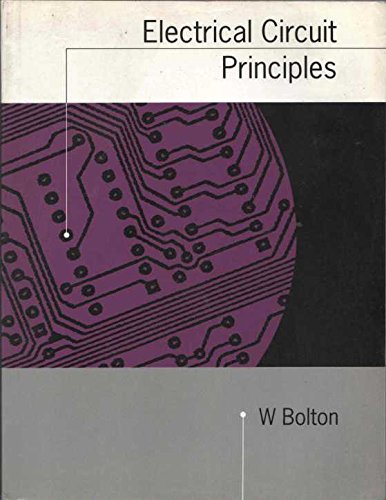
Electrical Circuit Principles by W Bolton
The overall aim of this book is to introduce and develop the principles of electrical circuit analysis such that: circuit theory can be applied to the solution of d.c. circuits involving series and parallel combinations of resistors; the transient behaviour of simple RL, RC and RLC circuits can be explained; phasors can be used to explain the behaviour of, and solve problems involving, single phase a.c. circuits; complex notation can be applied to the solution of single phase a.c. circuits involving series and parallel combinations of resistors, inductors and capacitors; circuit theory can be applied to magnetically coupled circuits; circuit theory can be applied to tuned circuits; circuit theory can be developed and applied to two-port networks; the behaviour of singals transmitted along transmission lines can be determined; the basic theory of three-phase circuits can be developed and applied to both balanced and unbalanced cirucits; the Laplace transform and the concept of a transfer function can be used in circuit analysis; circuit problems involving complex waves can be solved. While it is assumed that the reader has some basic knowleedge of electrical circuit principles the opportunity has been taken in chapter 1 and 2, and where appropriate in later chapters, to give a quick consideration of the basic principles. A basic knowledge of algebra, the handling of angles and calculus has been assumed. While it is recognized that circuit analysis of any complexity is generally carried out using a computer, it was felt that within a book devoted to the establishment of principles the exercise of working out things "by hand" was more appropriate and would then enable the reader to use computer programs intelligently and be more able to interpret the results effectively. The book includes 184 worked examples and 283 problems, all with answers supplied. The book aims to give a comprehensive coverage of all electrical circuit principles. It is seen as being particularly relevant to students taking Business and Technician Education Council Higher National Certificate and Diploma courses in Electrical and Electronic Engineering and students in the early years of degree courses in Electrical and Electronic Engineering. The book covers all the electric circuit principles of the Business and Technician Education Council Bank of Objectives for Electrical and Electronic principles (13683B) for Higher National Courses, revising all those circuit principles covered in the Bank of Objectives for Electrical and Electronic principles (U86/329) for National Courses.
Bolton, William: - Former Lecturer at Buckingham Chilterns University College, High Wycombe, UK, and now retired, William Bolton has worked in industry and academia as a senior lecturer in a college of technology, a member of the Nuffield Advanced Physics team, an adviser to a British government aid project in Brazil on technical education, as a UNESCO consultant in Argentina and Thailand, and as Head of Research and Development at the Business and Technician Education Council. He has written many engineering textbooks, including Mechatronics, 4th ed., Engineering Science, 5th ed., Higher Engineering Science, 2nd ed., Mechanical Science, 3rd ed., and Instrumentation and Control Systems.
| SKU | Unavailable |
| ISBN 13 | 9780582088023 |
| ISBN 10 | 058208802X |
| Title | Electrical Circuit Principles |
| Author | W Bolton |
| Condition | Unavailable |
| Binding Type | Paperback |
| Publisher | Pearson Education Limited |
| Year published | 1992-12-17 |
| Number of pages | 432 |
| Cover note | Book picture is for illustrative purposes only, actual binding, cover or edition may vary. |
| Note | Unavailable |