


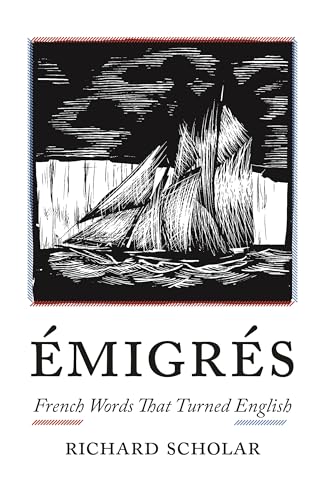
Emigres by Richard Scholar
English has borrowed more words from French than from any other modern foreign language. French words and phrases-such as a la mode, ennui, naivete and caprice-lend English a certain je-ne-sais-quoi
"Who needs ennui when we have old-fashioned boredom?. . Scholar’s émigrés often manage to be posh and phoney at the same time, while still carrying a kind of precision it would be hard to find without them. . . . [In Émigrés] words have historical lives and tell us stories we may not know how to hear."---Michael Wood, London Review of Books
"A well-researched, convincing account of how our language has welcomed foreign words—but not always their native speakers." * Kirkus Reviews *
"Scholar . . . reflects thoughtfully and sometimes surprisingly on the use of French words in English. . . . Given the current interest in immigration, Scholar’s book on immigrant words is erudite, witty, and surprisingly timely." * Publishers Weekly *
"Like the émigré lexical items themselves, Emigrés crackles with hidden energy and is worth serious study." * Choice *
"The émigrés that Scholar highlights—à la mode, galanterie, naïveté, ennui, and caprice—don’t assimilate and, in this act of resistance, reveal new ways of being."---Meghan K. McGinley, AmeriQuests
"This thoughtful summation of how much English owes to French, and other languages, has a certain je-ne-sais-quoi and cultural relevance."---David Caddy, Tears in the Fence
"[A] lively and always entertaining book. . . . Although Professor Scholar clearly has a wealth of learning at his fingertips, enjoyment of Émigrés need not be limited to academic readers. The book will be readily understood by academic and non-specialist readers alike. . . . The habit of using émigré words is infectious: for his sang-froid, savoir faire, and bonhomie in guiding us on this voyage through the complexities of our national love-hate relationship with French—and the French—we are all indebted to Richard Scholar."---Annette Tomarken, H-France Review
"The ‘émigrés’ of this engaging book . . . occupy an uneasy centre ground between donor and borrower language, being neither French nor fully integrated into English. This ambiguity, Richard Scholar argues, reflects a long-standing ambivalence in English cultural attitudes to things French, ranging from fascination to disdain. . . . The book takes us on an eclectic journey from Restoration comedy to Winnie-the-Pooh’s companion Eeyore, John Le Carré and the Oscar-winning Little Miss Sunshine."---David Hornsby, Modern Language Review
"Émigrés . . . takes an approach informed by both French and English literature, and sets its findings in a cultural context which is wider still. This is pleasing, as the historical study of language perishes in a vacuum. . . . [A] humane and humanistic book."---Anthony Grant, French Studies
"The dream of a primordial linguistic simplicity has a flip side: the fear of linguistic creolization followed by a loss of national identity. Richard Scholar’s book exorcises this atavistic fear."---Maria Neklyudova, Shagi / Steps.
"Fascinating and informative. His research is excellent, he writes clearly, and the book is full of charming and memorable detail . . . .[Scholar] has written a captivating book in an accessible style. It would be good if reading him became de rigueur among students of language and literature, but perhaps ça serait trop beau."---Alan Dent, Northern Review of Books
"This is a rich and rewarding book with plenty of linguistic faits divers and an impressive array of cultural references. . . .An excellent case for reconsidering the cultural and political significance of terms that retain their foreignness, even in a language as globally dominant as English."---Emma Herdman, Forum for Modern Language Studies
"A well-researched, convincing account of how our language has welcomed foreign words—but not always their native speakers." * Kirkus Reviews *
"Scholar . . . reflects thoughtfully and sometimes surprisingly on the use of French words in English. . . . Given the current interest in immigration, Scholar’s book on immigrant words is erudite, witty, and surprisingly timely." * Publishers Weekly *
"Like the émigré lexical items themselves, Emigrés crackles with hidden energy and is worth serious study." * Choice *
"The émigrés that Scholar highlights—à la mode, galanterie, naïveté, ennui, and caprice—don’t assimilate and, in this act of resistance, reveal new ways of being."---Meghan K. McGinley, AmeriQuests
"This thoughtful summation of how much English owes to French, and other languages, has a certain je-ne-sais-quoi and cultural relevance."---David Caddy, Tears in the Fence
"[A] lively and always entertaining book. . . . Although Professor Scholar clearly has a wealth of learning at his fingertips, enjoyment of Émigrés need not be limited to academic readers. The book will be readily understood by academic and non-specialist readers alike. . . . The habit of using émigré words is infectious: for his sang-froid, savoir faire, and bonhomie in guiding us on this voyage through the complexities of our national love-hate relationship with French—and the French—we are all indebted to Richard Scholar."---Annette Tomarken, H-France Review
"The ‘émigrés’ of this engaging book . . . occupy an uneasy centre ground between donor and borrower language, being neither French nor fully integrated into English. This ambiguity, Richard Scholar argues, reflects a long-standing ambivalence in English cultural attitudes to things French, ranging from fascination to disdain. . . . The book takes us on an eclectic journey from Restoration comedy to Winnie-the-Pooh’s companion Eeyore, John Le Carré and the Oscar-winning Little Miss Sunshine."---David Hornsby, Modern Language Review
"Émigrés . . . takes an approach informed by both French and English literature, and sets its findings in a cultural context which is wider still. This is pleasing, as the historical study of language perishes in a vacuum. . . . [A] humane and humanistic book."---Anthony Grant, French Studies
"The dream of a primordial linguistic simplicity has a flip side: the fear of linguistic creolization followed by a loss of national identity. Richard Scholar’s book exorcises this atavistic fear."---Maria Neklyudova, Shagi / Steps.
"Fascinating and informative. His research is excellent, he writes clearly, and the book is full of charming and memorable detail . . . .[Scholar] has written a captivating book in an accessible style. It would be good if reading him became de rigueur among students of language and literature, but perhaps ça serait trop beau."---Alan Dent, Northern Review of Books
"This is a rich and rewarding book with plenty of linguistic faits divers and an impressive array of cultural references. . . .An excellent case for reconsidering the cultural and political significance of terms that retain their foreignness, even in a language as globally dominant as English."---Emma Herdman, Forum for Modern Language Studies
Richard Scholar is Professor of French at Durham University. His books include The Je-Ne-Sais-Quoi in Early Modern Europe: Encounters with a Certain Something and Montaigne and the Art of Free-Thinking.
| SKU | Unavailable |
| ISBN 13 | 9780691190327 |
| ISBN 10 | 0691190321 |
| Title | Emigres |
| Author | Richard Scholar |
| Condition | Unavailable |
| Binding Type | Hardback |
| Publisher | Princeton University Press |
| Year published | 2020-08-18 |
| Number of pages | 272 |
| Cover note | Book picture is for illustrative purposes only, actual binding, cover or edition may vary. |
| Note | Unavailable |