
Empirical Market Microstructure


Summary
The feel-good place to buy books
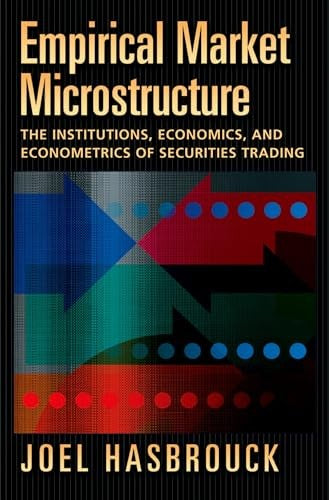
Empirical Market Microstructure by Joel Hasbrouck
The interactions that occur in securities markets are among the fastest, most information-intensive, and most highly strategic of all economic phenomena. Empirical Market Microstructure is about the institutions that have evolved to handle our trading needs, the economic forces that guide our strategies, and statistical methods of using and interpreting the vast amount of information that these markets produce. The empirical methods discussed in the book draw on the power of multivariate linear time series analysis. The book discusses the application of univariate ARMA analysis to trade prices, vector autoregressions to price and order data, and vector error correction models to situations where the same security is traded in many markets. In these models, the tools of random-walk decomposition and co-integration emerge as important to specification and interpretation. The statistical specifications dont simply arise, however, as progressively more refined descriptive models; they have strong economic underpinnings arising from asymmetric information, inventory control, and the strategies of their participants. These topics are discusssed, interleaving with and emphasizing the connection to the statistical models. From a practical viewpoint, many of these models will be estimated to calibrate real-world trading strategies. Some market participants will be trying to discern strategies that generate profits from short-term trading. A much greater number, though, will be trying to accomplish trades that help diversify, hedge or reallocate a portfolio. Trading is not, for these agents, their primary economic purpose. They are simply trying to satisfy their trading needs at a minimal cost. The final part of the book discusses how these costs are measured, and strategies to minimize them--both by splitting orders over time, and by the judicious use of limit orders. The book includes numerous exercises; solutions and other supporting materials are available on the author's web site.
Joel Hasbrouck provides the first integrated introduction to the most important models of empirical market microstructureThe development is logical and easy to follow. Students and practioners will undoubtedly greatly appreciate the care with which Hasbrouck has identified the strengths and weaknesses of the models, and their relations to each other. This book represents an outstanding synthesis of academic work over the last 20 years. * Larry Harris, Fred V. Keenan Chair in Finance, USC Marshall School of Business and author of Trading and Exchanges (OUP, 2002) *
Joel Hasbrouck is the Kenneth G. Langone Professor of Business Administration and Professor of Finance at the Stern School of Business, New York University. In addition to teaching at Stern, he has served as a constultant to the New York Stock Exchange and the American Stock Exchange, and on the scientific adviosry board of ITG, Inc. and Nasdaq's economic advisory board.
| SKU | Unavailable |
| ISBN 13 | 9780195301649 |
| ISBN 10 | 0195301641 |
| Title | Empirical Market Microstructure |
| Author | Joel Hasbrouck |
| Condition | Unavailable |
| Binding Type | Hardback |
| Publisher | Oxford University Press Inc |
| Year published | 2007-01-18 |
| Number of pages | 208 |
| Cover note | Book picture is for illustrative purposes only, actual binding, cover or edition may vary. |
| Note | Unavailable |