


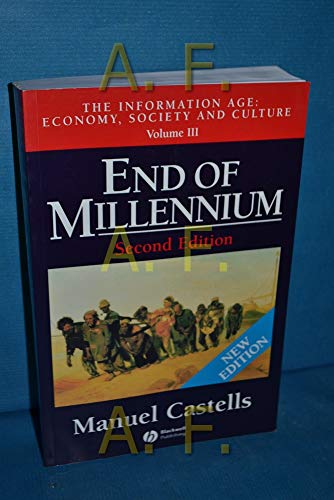
End of Millennium by Manuel Castells
The final volume in Manuel Castells' trilogy is devoted to processes of global social change induced by interaction between networks and identity. Castells studies empirically the collapse of the Soviet Union, tracing it back to the incapacity of industrial statism to manage the transition to the Information Age. He shows the rise of inequality, polarization, and social exclusion throughout the world, focusing on Africa, urban poverty, and the plight of children. He documents the formation of a global criminal economy that deeply affects economies and politics in many countries. He analyzes the political and cultural foundations of the emergence of the Asian Pacific as a critically important region in the global economy. And he reflects on the contradictions of European unification, proposing the concept of the network state. The new edition of End of Millennium includes a revised chapter on Pacific Asia taking into account recent trends, while the book has also been updated to account for developments in the European Union. In the general conclusion of the trilogy, included in this volume, Castells draws together the threads of his arguments and his findings, presenting a systematic interpretation of our world.
The most compelling attempt yet made to map the contours of the global information ageAnthony Giddens, New Statesman. A superlative achievement. Castells has succeeded in producing a study that positively invites comparison with Marx. As Marx in Capital sought to analyze the operation and social tensions of early industrial capitalism, so Castells in his trilogy aims to understand the system, global informational capitalism, that is replacing it. He has thus set himself the ultimate challenge; the confirmation is already to hand that he has met it. Peter Hall, Cities. Not since Weber has there been such a determined and largely successful effort to bring to bear the results and analytical perspectives of all the social sciences on the evolution of society. It is to be hoped that his book will be read by social scientists of all kinds, but especially by economists since they, probably more than anyone else, need to be reminded that Max Weber was a professor of economics. Chris Freeman, New Political Economy. A magnum opus if ever there was one, these three books together constitute, in my view, the finest piece of contemporary social analysis for at least a generation. Frank Webster, British Journal of Sociology.
| SKU | Unavailable |
| ISBN 13 | 9780631221395 |
| ISBN 10 | 0631221395 |
| Title | End of Millennium |
| Author | Manuel Castells |
| Series | The Information Age |
| Condition | Unavailable |
| Binding Type | Paperback |
| Publisher | John Wiley and Sons Ltd |
| Year published | 2000-06-25 |
| Number of pages | 464 |
| Cover note | Book picture is for illustrative purposes only, actual binding, cover or edition may vary. |
| Note | Unavailable |