
Engines and Innovation


Engines and Innovation
Regular price
Checking stock...
Regular price
Checking stock...
World of Books
At World of Books, you’ll find millions of preloved reads at great prices, from bestsellers to hidden gems. Every book you buy saves money and helps reduce waste, so you can read more for less while giving stories a second life.
The feel-good place to buy books
- Free US shipping over $15
- Buying preloved emits 41% less CO2 than new
- Millions of affordable books
- Give your books a new home - sell them back to us!
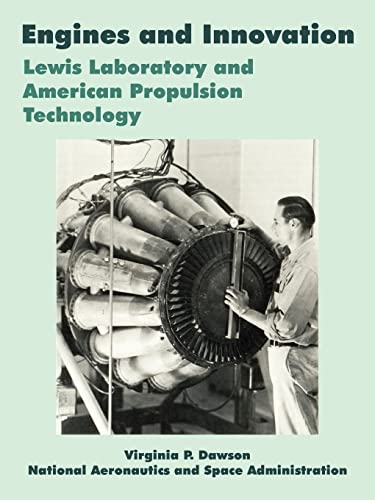
Engines and Innovation by Author Virginia P Dawson
When Francis Bacon wrote the New Atlantis in the early 17th century, he envisioned a state-supported research institution in which knowledge could be applied to 'enlarge the bounds of Human Empire, to the effecting of all things possible. Among the research facilities to increase the protection and material comforts of the inhabitants of his imaginary island, Bacon imagined an Engine House to study all types of motion, including flight. National aeronautical research laboratories in Europe and the United States in the early 20th century reflected Bacon's vision of science applied to the practical problems of flight. Commitment to innovation accompanied Bacon's belief in progress. His utopia honored inventors, not politicians or academics. In 1941 the same commitment to innovation and industrial progress won federal funding for a laboratory in Cleveland, Ohio. Local and national leaders expected the new laboratory to promote innovations in aircraft engine technology to help win the war against Germany. Contributions to the development of superior engines for military and passenger aircraft after World War I justified the large federal investment in research facilities and personnel. Today this laboratory is the NASA Lewis Research Center. In contrast to the isolation of the ideal research institution of Bacon's vision, Lewis took shape in a flesh-and-blood world of personalities, national security concerns, and postwar capitalism. Two transitions, both precipitated by advances in propulsion technology, provide the structure for my history: the revolution in jet propulsion during World War I, and the launch of Sputnik in October 1957. Each had significant national political, military, and economic repercussions. Each forced the laboratory to restructure its research program and to redefine its relationships with its three constituencies--the military, industry, and academia. Within this framework I have distinguished one theme that recurs throughout the laboratory's history--the tension between fundamental or basic research and development. In the process of writing my history I found that these terms could not be defined in any absolute sense. Their meaning is enmeshed in the history of Lewis, and the definitions of research and development changed as Lewis evolved. As an institution, Lewis engaged in a continuing reevaluation of its role within the American propulsion community and, after the formation of NASA in 1958, within a vastly expanded federal bureaucracy.
I started out, back in the 1970s, as a National Park Service Ranger/Historian in Gettysburg, PA. I knew that I wanted to be a writer, so after five years with the NPS, I got the crazy idea that I should start my own research and writing company. Thus began Interpretive Enterprises. I spent several years as a freelance writer and wondering if I had lost my mind. My first book was a children's book: The Little Drummer Boy. It won an award and boosted my confidence. I had been collecting ghost stories of the Gettysburg area since I first arrived, so I decided to approach a local publisher to see if they'd be interested in a book about the Ghosts of Gettysburg. The first ghost book came out in 1991. Since then, I have written fifteen books, covering topics of historical interest, as well as the paranormal. My stories have been seen on The History Channel, A&E, The Discovery Channel, The Travel Channel, Unsolved Mysteries, The Biography Channel, and numerous regional television shows and heard on Coast to Coast AM, and regional radio. In 1994, I founded The Ghosts of Gettysburg Candlelight Walking Tours(R), a tour based on the stories in my book series. The tour company started out on a card table in the town square. The next year I rented office space at the corner of Baltimore St. and Steinwehr Ave. Finally, in 1997, I purchased the current headquarters building at 271 Baltimore St. In 2006, I expanded into Frederickburg, VA and started the Ghosts of Fredericksburg Tours.
| SKU | Unavailable |
| ISBN 13 | 9781410220387 |
| ISBN 10 | 1410220389 |
| Title | Engines and Innovation |
| Author | Author Virginia P Dawson |
| Condition | Unavailable |
| Binding Type | Paperback |
| Publisher | University Press of the Pacific |
| Year published | 2005-02-14 |
| Number of pages | 288 |
| Cover note | Book picture is for illustrative purposes only, actual binding, cover or edition may vary. |
| Note | Unavailable |