
The Enlightenment of Sympathy


World of Books
The feel-good place to buy books
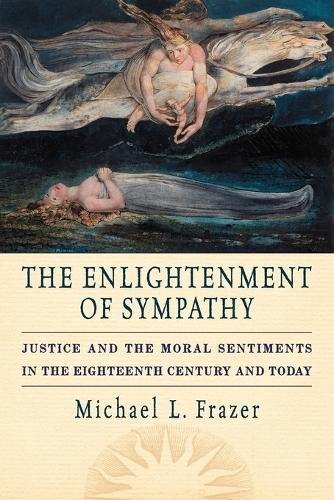
The Enlightenment of Sympathy by Michael L Frazer
Enlightenment thinkers of the eighteenth century were committed to the ideal of reflective autonomy--the principle that each of us should think for ourselves, particularly when determining moral and political standards. In keeping with that era's reputation as "the age of reason," many interpreted autonomy in a distinctively rationalist way--privileging reflective reason over all other mental faculties. However, other leading philosophers of the era--such as David Hume, Adam Smith, and J.G. Herder--placed greater emphasis on feeling, seeing moral and political reflection as the proper work of the mind as a whole. They argued that without emotion, imagination, and sympathy we would be incapable of developing the moral sentiments that form the basis of our commitment to justice and virtue. The Enlightenment of Sympathy reclaims the sentimentalist theory of reflective autonomy as a resource for enriching social science, normative theory, and political practice today. The sentimentalist description of the reflective process is more empirically accurate than the competing rationalist description, and can guide scientists investigating the processes by which the mind formulates moral and political principles. Yet the theory is much more than merely descriptive, and can also contribute to the philosophical project of finding principles--including principles of justice--that wield genuine normative authority. Enlightenment sentimentalism demonstrates that emotion is necessarily central to our civic life, and shows how our reflective sentiments can counterbalance the unreflective feelings that might otherwise lead our political principles astray.
Michael Frazer has written a thought-provoking analysis and defense of sentimentalist theoryHis excellent book is well written and carefully researched, offering insightful discussions of a wide range of thinkers. It will be of great interest to students and scholars working in, among other areas, moral theory, political theory, and eighteenth-century thought. * Charles L. Griswold, Professor of Philosophy, Boston University, and author of Forgiveness: A Philosophical Exploration *
Michael Frazer's The Enlightenment of Sympathy corrects a widely entrenched but nonetheless benighted reading of the Enlightenment. Frazer shows how the sentimentalist branch of the enlightenment anticipates much recent scholarship, both philosophical and neuroscientific, on the essential role of emotion. This precise and deft project of recovery should be read by anyone who wishes to be enthused by this superbly argued prophetic endeavor. * George E. Marcus, Professor of Political Science, Williams College, and author of The Sentimental Citizen *
Michael Frazer's The Enlightenment of Sympathy corrects a widely entrenched but nonetheless benighted reading of the Enlightenment. Frazer shows how the sentimentalist branch of the enlightenment anticipates much recent scholarship, both philosophical and neuroscientific, on the essential role of emotion. This precise and deft project of recovery should be read by anyone who wishes to be enthused by this superbly argued prophetic endeavor. * George E. Marcus, Professor of Political Science, Williams College, and author of The Sentimental Citizen *
Michael L. Frazer is an Assistant Professor of Government and Social Studies at Harvard University. His research focuses on Enlightenment political philosophy and its relevance for contemporary political theory. Professor Frazer has also published articles on Maimonides, Nietzsche, John Rawls and Leo Strauss in such journals as Political Theory and The Review of Politics. Before arriving at Harvard, he studied at Yale and Princeton Universities, and received a postdoctoral appointment in the Political Theory Project at Brown University. He lives in Somerville, MA with his wife Coral and son Oren.
| SKU | Unavailable |
| ISBN 13 | 9780199920235 |
| ISBN 10 | 0199920230 |
| Title | The Enlightenment of Sympathy |
| Author | Michael L Frazer |
| Condition | Unavailable |
| Binding Type | Paperback |
| Publisher | Oxford University Press Inc |
| Year published | 2012-09-27 |
| Number of pages | 246 |
| Cover note | Book picture is for illustrative purposes only, actual binding, cover or edition may vary. |
| Note | Unavailable |