
Explaining Tort and Crime


Explaining Tort and Crime
Regular price
Checking stock...
Regular price
Checking stock...
Summary
This book explains how and why tort law and criminal law developed in England compared with other legal systems, from 1850 to 2020. It uses comparative law and legal history techniques to understand fault concepts, such as intention, recklessness and negligence, and procedures linking tort and crime.
The feel-good place to buy books
- Free US shipping over $15
- Buying preloved emits 41% less CO2 than new
- Millions of affordable books
- Give your books a new home - sell them back to us!
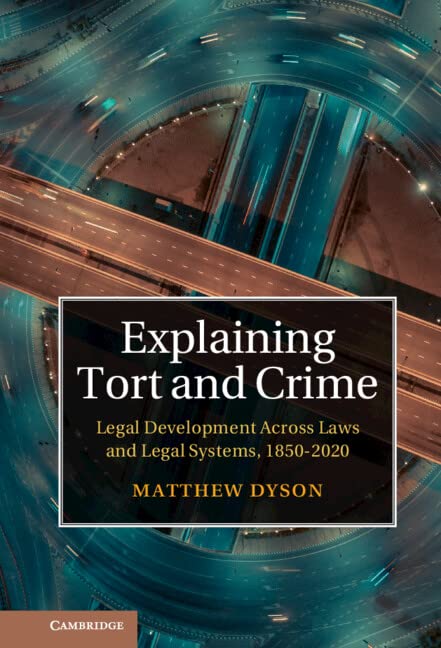
Explaining Tort and Crime by Matthew Dyson
Tracing almost 200 years of history, Explaining Tort and Crime explains the development of tort law and criminal law in England compared with other legal systems. Referencing legal systems from around the globe, it uses innovative comparative and historical methods to identify patterns of legal development, to investigate the English law of fault doctrine across tort and crime, and to chart and explain three procedural interfaces: criminal powers to compensate, timing rules to control parallel actions, and convictions as evidence in later civil cases. Matthew Dyson draws on decades of research to offer an analysis of the field, examining patterns of legal development, visible as motifs in the law of many legal systems.
Matthew Dyson is Professor of Civil and Criminal Law at the Faculty of Law, University of Oxford, and a Tutorial Fellow at Corpus Christi College, Oxford. He is also an Associate Member of 6KBW College Hill Chambers, and a Visiting Professor and Senior Fellow at the Notre Dame London Law Program. He was previously a Fellow of Jesus College, Cambridge and then Trinity College, Cambridge. He teaches tort law, criminal law, Roman law, comparative law and European legal history.
| SKU | Unavailable |
| ISBN 13 | 9781107144866 |
| ISBN 10 | 1107144868 |
| Title | Explaining Tort and Crime |
| Author | Matthew Dyson |
| Condition | Unavailable |
| Binding Type | Hardback |
| Publisher | Cambridge University Press |
| Year published | 2022-07-21 |
| Number of pages | 448 |
| Cover note | Book picture is for illustrative purposes only, actual binding, cover or edition may vary. |
| Note | Unavailable |