


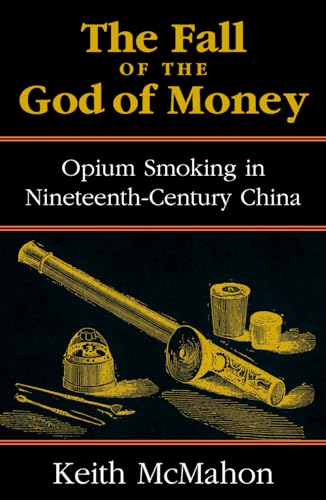
The Fall of the God of Money by Keith Mcmahon
In this first truly cross-cultural study of opium, Keith McMahon considers the perspectives of both smokers and non-smokers from China and the Euro-West and from both sides of the issue of opium prohibition. The author stages a dramatic confrontation between the Chinese opium user and the Euro-Westerner who saw in opium the image of an uncanny Asiatic menace. Opium was inextricably bound up with generalizations made about teeming Asiatic masses, nightmarish opium sots, effeminate Chinamen, and orientalized white women. In China, opium--called the Western Drug--was tied to the arrival of Christianity and Western greed. The rise of the opium demon meant the fall of the god of money, that is, Chinese money, and the irreversible trend in which Confucianism gave way to Christianity. McMahon makes the case for opium smoking as a way of life that, far from being merely wanton, was an entirely reasonable choice in times when smokers could be neither Christian nor Confucian. Opium smoking was a way of inhabiting an era in which traditional loyalties were in critical transition. The author convincingly demonstrates that the current laws against drugs of addiction have their origins in this early modern conflict of cultures and not in any supposed scientific evidence that opium is so definitively worse than alcohol. The book explores early Western observations of opium smoking, the formation of arguments for and against the legalization of opium, the portrayals of opium smoking in Chinese poetry and prose, and scenes of opium-smoking interactions among male and female smokers and smokers of all social levels in 19th-century China. By providing the first translation ever of a unique 1878 autobiography of a Chinese addict, McMahon is able to explore the opium smoker's own observations on China and opium smoking. No other studies have focused attention so richly on opium smokers, their language, the scenes of their smoking together, their gendered interactions, and their relations with family and society.
Keith McMahon's monograph is a genuine contribution to the late Qing opium discourse, even today often mired in the unreflected condemnation of a complex and sophisticated smoking culture-- Lars Peter Laaman * Bulletin of the School of Oriental and African Studies *
This study contributes to the cultural history of late imperial China and the contemporaneous West. Recommended. * CHOICE *
This study contributes to the cultural history of late imperial China and the contemporaneous West. Recommended. * CHOICE *
Keith McMahon is professor and chair of the East Asian Languages and Cultures Department at the University of Kansas.
| SKU | Unavailable |
| ISBN 13 | 9780742518032 |
| ISBN 10 | 0742518035 |
| Title | The Fall of the God of Money |
| Author | Keith Mcmahon |
| Condition | Unavailable |
| Binding Type | Paperback |
| Publisher | Bloomsbury Publishing Plc |
| Year published | 2002-06-11 |
| Number of pages | 256 |
| Cover note | Book picture is for illustrative purposes only, actual binding, cover or edition may vary. |
| Note | Unavailable |