


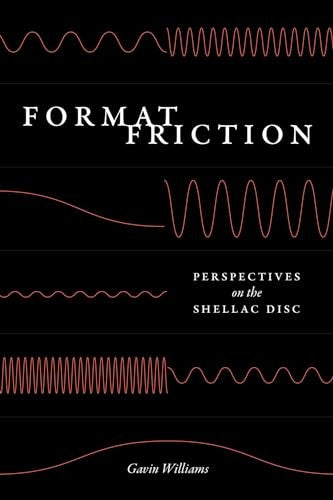
Format Friction by Gavin Williams
The first book to consider the shellac disc as a global format. With the rise of the gramophone around 1900, the shellac disc traveled the world and eventually became the dominant sound format in the first half of the twentieth century. Format Friction brings together a set of local encounters with the shellac disc, beginning with its preconditions in South Asian knowledge and labor, to offer a global portrait of this format. Spun at seventy-eight revolutions per minute, the shellac disc rapidly became an industrial standard even while the gramophone itself remained a novelty. The very basis of this early sound reproduction technology was friction, an elemental materiality of sound shaped through cultural practice. Using friction as a lens, Gavin Williams illuminates the environments plundered, the materials seized, and the ears entangled in the making of a sound format. Bringing together material, political, and music history, Format Friction decenters the story of a beloved medium, and so explores new ways of understanding listening in technological culture more broadly.
“With the conceptual elegance of a nondogmatic philosopher, the fine attunement of an open-eared political theorist, and the sensibilities of a historian, Williams generously gives us a finely grained and riveting story of how, why, where, and who comes into relation and entanglement when we harness sound to a material (shellac) and a format (the disc)Like the friction required for the gramophone needle to render discs into sound, Format Friction rubs against the political economies that bind materials and audiences, materiality and listening, and nature(s) and culture(s), so that the desires and imaginations of laborers, makers, sellers, consumers, thinkers, and tinkerers may yet be heard through a thicket of competing global forces. A stunning work.” * Jairo Moreno, University of Pennsylvania *
“Format Friction tracks the movements of shellac from the labor of the insects and the humans in British India who gathered, washed, and stretched lac through programming and advertising decisions made in the boardrooms of early twentieth-century Singapore to the way the temporalities of musical playback inflected Jean-Paul Sartre’s concept of nothingness. Throughout this fiercely materialist and deeply humane material history, Williams stares down the corporate logic that powered the global movement of goods and musical performances. For Williams, recorded sound is friction—the friction of needle against shellac surface, but also among the various imperial, capitalist, and politically subversive agendas that attach to specific recordings. With its unique blend of dense historical narrative and courageous assessment of the power dynamics behind those histories, Format Friction provides an inspiring new model for thinking about the interactions between music technologies and musical experience.” * Mary Ann Smart, University of California, Berkeley *
“Format Friction tracks the movements of shellac from the labor of the insects and the humans in British India who gathered, washed, and stretched lac through programming and advertising decisions made in the boardrooms of early twentieth-century Singapore to the way the temporalities of musical playback inflected Jean-Paul Sartre’s concept of nothingness. Throughout this fiercely materialist and deeply humane material history, Williams stares down the corporate logic that powered the global movement of goods and musical performances. For Williams, recorded sound is friction—the friction of needle against shellac surface, but also among the various imperial, capitalist, and politically subversive agendas that attach to specific recordings. With its unique blend of dense historical narrative and courageous assessment of the power dynamics behind those histories, Format Friction provides an inspiring new model for thinking about the interactions between music technologies and musical experience.” * Mary Ann Smart, University of California, Berkeley *
Gavin Williams is a lecturer in music at King’s College London. He is the editor of Hearing the Crimean War: Wartime Sound and the Unmaking of Sense.
| SKU | Unavailable |
| ISBN 13 | 9780226833262 |
| ISBN 10 | 0226833267 |
| Title | Format Friction |
| Author | Gavin Williams |
| Series | New Material Histories Of Music |
| Condition | Unavailable |
| Binding Type | Paperback |
| Publisher | The University of Chicago Press |
| Year published | 2024-06-05 |
| Number of pages | 208 |
| Cover note | Book picture is for illustrative purposes only, actual binding, cover or edition may vary. |
| Note | Unavailable |