
The Fourth Industrial Revolution and Military-Civil Fusion


Summary
The feel-good place to buy books
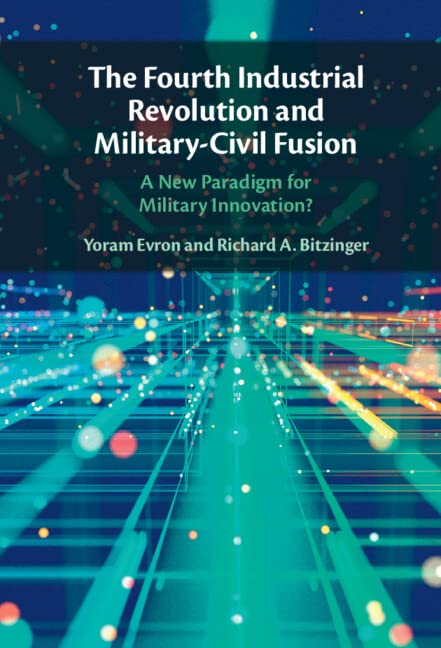
The Fourth Industrial Revolution and Military-Civil Fusion by Yoram Evron
Advanced commercial technologies offer new opportunities for defense applications that could greatly affect military power and metrics of military advantage. This is relevant when it comes to civilian-based technological innovations found in the emerging 'fourth industrial revolution,' such as artificial intelligence, autonomous systems, 'big data,' and quantum computing. Militaries and governments around the world are increasingly focused on how and where advanced commercial technologies, innovations, and breakthroughs could potentially create new capacities for military power, advantage, and leverage. This process of exploiting civilian-based advanced technologies is referred to as 'military–civil fusion' (MCF). This book addresses MCF not only from a conceptual and practical sense but also comparatively as it explores how four different countries – the United States, China, India, and Israel – are attempting to use MCF to support national military-technological innovation. It will interest scholars, researchers, and advanced students of military, security, and technology studies, as well as analysts and policymakers in military and defense organizations.
'This book is a much-needed contribution to the discussion of the growing importance of civilian industry to national defenseThe case studies it contains will be of interest to scholars and policymakers alike.' Thomas G. Mahnken, Senior Research Professor, Johns Hopkins SAIS; President and CEO, Center for Strategic and Budgetary Assessments
'This book presents an essential roadmap on how strategically significant militaries harness the technological potential of the 4IR through varying military-civil fusion strategies. Bitzinger and Evron offer new insights and advice on enablers and challenges to defense and military innovation in the twenty-first century.' Michael Raska, Assistant Professor and Coordinator of the Military Transformations Programme, S. Rajaratnam School of International Studies, Nanyang Technological University, Singapore
'Drawing on extensive research, the authors offer critical and nuanced insights on why and how states approach and deploy 4IR technologies in search of cutting-edge military capabilities through military-civil fusion (MCF). The book provides a comprehensive analysis of a critical development that not only will challenge the trajectory of warfare and influence key concepts such as deterrence and arms competitions. The unequal abilities of various militaries to exploit the technological potential will influence the distribution of power in the international system, with consequences for who gains and who loses.' Katarzyna Zysk, Professor of International Relations and Contemporary History, Norwegian Institute for Defence Studies (IFS)
'Two long-time observers of the changing global landscape for military technologies, Evron and Bitzinger have written an important and timely book on military-civil fusion. It has a clarifying conceptual chapter, and two on the US and China, respectively. Better, and of interest to policymakers and scholars across the globe, it applies ideas about military-civil fusion to two other critical cases - Israel and India. This is a must-read for scholars of military innovation and the shifting balance of military capabilities across the globe.' Peter Dombrowski, William B. Ruger Chair of National Security Economics, Naval War College
'I highly recommend this book to soldiers at all levels of the hierarchy. It serves as an invaluable source of ideas and aids in understanding the significance of socio-economic factors that must be addressed in military innovation and achieving success in warfare. At the strategic (e.g. general staff) level, reading the book should be a must…' Maj. Balázs Taksás, Defense & Security Analysis
'This book presents an essential roadmap on how strategically significant militaries harness the technological potential of the 4IR through varying military-civil fusion strategies. Bitzinger and Evron offer new insights and advice on enablers and challenges to defense and military innovation in the twenty-first century.' Michael Raska, Assistant Professor and Coordinator of the Military Transformations Programme, S. Rajaratnam School of International Studies, Nanyang Technological University, Singapore
'Drawing on extensive research, the authors offer critical and nuanced insights on why and how states approach and deploy 4IR technologies in search of cutting-edge military capabilities through military-civil fusion (MCF). The book provides a comprehensive analysis of a critical development that not only will challenge the trajectory of warfare and influence key concepts such as deterrence and arms competitions. The unequal abilities of various militaries to exploit the technological potential will influence the distribution of power in the international system, with consequences for who gains and who loses.' Katarzyna Zysk, Professor of International Relations and Contemporary History, Norwegian Institute for Defence Studies (IFS)
'Two long-time observers of the changing global landscape for military technologies, Evron and Bitzinger have written an important and timely book on military-civil fusion. It has a clarifying conceptual chapter, and two on the US and China, respectively. Better, and of interest to policymakers and scholars across the globe, it applies ideas about military-civil fusion to two other critical cases - Israel and India. This is a must-read for scholars of military innovation and the shifting balance of military capabilities across the globe.' Peter Dombrowski, William B. Ruger Chair of National Security Economics, Naval War College
'I highly recommend this book to soldiers at all levels of the hierarchy. It serves as an invaluable source of ideas and aids in understanding the significance of socio-economic factors that must be addressed in military innovation and achieving success in warfare. At the strategic (e.g. general staff) level, reading the book should be a must…' Maj. Balázs Taksás, Defense & Security Analysis
Yoram Evron is Associate Professor of Political Science and Chinese studies at the University of Haifa, Israel. His articles have appeared in the Journal of Strategic Studies, Pacific Review, and China Quarterly. He is the author of China's Military Procurement in the Reform Era (2016). Richard A. Bitzinger is a senior fellow at the S. Rajaratnam School of International Studies. His articles have appeared in International Security, Orbis, and Survival. He is the author of Arming Asia: Technonationalism and Its Impact on Local Defence Industries (2016) and the editor of Defence Industries in the 21st Century (2021).
| SKU | Unavailable |
| ISBN 13 | 9781009333283 |
| ISBN 10 | 1009333283 |
| Title | The Fourth Industrial Revolution and Military-Civil Fusion |
| Author | Yoram Evron |
| Condition | Unavailable |
| Publisher | Cambridge University Press |
| Year published | 2023-06-15 |
| Number of pages | 300 |
| Cover note | Book picture is for illustrative purposes only, actual binding, cover or edition may vary. |
| Note | Unavailable |