
Fragmentation in East Central Europe


Summary
The feel-good place to buy books
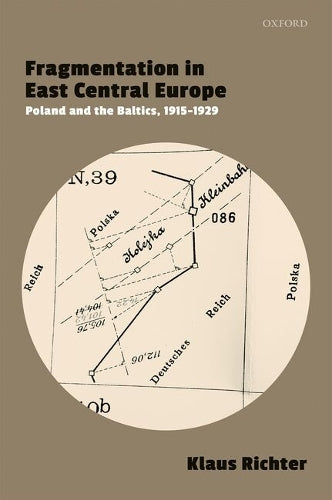
Fragmentation in East Central Europe by Klaus Richter
The First World War led to a radical reshaping of Europe's political borders. Nowhere was this transformation more profound than in East Central Europe, where the collapse of imperial rule led to the emergence of a series of new states. New borders intersected centuries-old networks of commercial, cultural, and social exchange. The new states had to face the challenges posed by territorial fragmentation and at the same time establish durable state structures within an international order that viewed them as, at best, weak, and at worst, as merely provisional entities that would sooner or later be reintegrated into their larger neighbours' territory. Fragmentation in East Central Europe challenges the traditional view that the emergence of these states was the product of a radical rupture that naturally led from defunct empires to nation states. Using the example of Poland and the Baltic States, it retraces the roots of the interwar states of East Central Europe, of their policies, economic developments, and of their conflicts back to the First World War. At the same time, it shows that these states learned to harness the dynamics caused by territorial fragmentation, thus forever changing our understanding of what modern states can do.
This book makes a great contribution to multiple fields: Baltic studies, modern European history, and political and international history* Dr. Vejas Gabriel Liulevicius, Assosiation for the Advancement of Baltic Studies *
The collapse of imperial rule following WW I transformed East Central Europe by sanctioning the emergence of new states. In this solidly documented scholarly analysis, Richter (Univ. of Birmingham, UK) seeks to revise some traditional understandings of how this happened and what the nature of this process was. He asserts that the region's fragmentation began during the war, initiated by Germany, and affected much that followed, including statist approaches that endured into the interwar period. ... There is a fine attention to detail in this volume, which assumes substantial background knowledge. Though closely argued, the book's conclusions bear significantly upon how one understands the post-Cold War order in this region. * P. W. Knoll, CHOICE *
In his superbly researched and persuasively argued Fragmentation in East-Central Europe: Poland and the Baltics, 1915-1929, Klaus Richter analyzes the phenomenon of the interaction between national sovereignty and fragmentation during the First World War and its aftermath....We hope there will be more to come of monographs like his. * Marek Jan Chodakiewicz, Polonia Institute *
...remarkable... * Tomas Balkelis, Journal of Baltic Studies *
The collapse of imperial rule following WW I transformed East Central Europe by sanctioning the emergence of new states. In this solidly documented scholarly analysis, Richter (Univ. of Birmingham, UK) seeks to revise some traditional understandings of how this happened and what the nature of this process was. He asserts that the region's fragmentation began during the war, initiated by Germany, and affected much that followed, including statist approaches that endured into the interwar period. ... There is a fine attention to detail in this volume, which assumes substantial background knowledge. Though closely argued, the book's conclusions bear significantly upon how one understands the post-Cold War order in this region. * P. W. Knoll, CHOICE *
In his superbly researched and persuasively argued Fragmentation in East-Central Europe: Poland and the Baltics, 1915-1929, Klaus Richter analyzes the phenomenon of the interaction between national sovereignty and fragmentation during the First World War and its aftermath....We hope there will be more to come of monographs like his. * Marek Jan Chodakiewicz, Polonia Institute *
...remarkable... * Tomas Balkelis, Journal of Baltic Studies *
Klaus Richter is a historian of modern Central and Eastern Europe. He received his PhD in 2012 from the Technical University of Berlin, after which he held a research position at the German Historical Institute in Warsaw. He is currently working as Senior Lecturer and Birmingham Fellow at the University of Birmingham, and is director of the Birmingham Research Institute for History and Cultures (BRIHC). His previous book, Antisemitismus in Litauen. Christen, Juden und die 'Emanzipation' der Bauern, 1889-1914 (2013), was a study on Christian-Jewish relations in the Russian Empire's Lithuanian provinces. He is also the author of numerous articles and book chapters on the social history of East Central Europe as well as on the history of nationalism, ethnic conflict, and displacement.
| SKU | Unavailable |
| ISBN 13 | 9780198843559 |
| ISBN 10 | 0198843550 |
| Title | Fragmentation in East Central Europe |
| Author | Klaus Richter |
| Condition | Unavailable |
| Publisher | Oxford University Press |
| Year published | 2020-04-14 |
| Number of pages | 368 |
| Cover note | Book picture is for illustrative purposes only, actual binding, cover or edition may vary. |
| Note | Unavailable |