
General Principles of Quantum Mechanics


Summary
The feel-good place to buy books
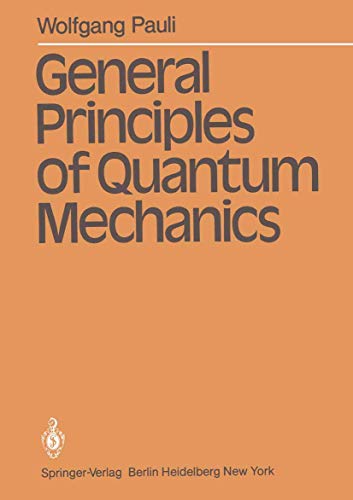
General Principles of Quantum Mechanics by Wolfgang Pauli
I am very happy to accept the translators' invitation to write a few lines of introduction to this book. Of course, there is little need to explain the author. Pauli's first famous work, his article on the theory of relativity in the Encyc opiidie der Mathematischen Wissenschaften was written at the age of twenty. He afterwards took part in the development of atomic physics from the still essentially classical picture of Bohr's early work to the true quantum mechanics. Thereaftt'f, some of his work concerned the treatment of problems in the framework of the new theory, especially his paper on the hydrogen atom following the matrix method without recourse to Schrodinger's analytic form of the theory. His greatest achievement, the exclusion principle, generally known today under his own name as the Pauli principle, that governs the quantum theory of all problems including more than one electron, preceded the basic work of Heisenberg and Schrodinger, and brought him the Nobel prize. It includes the mathematical treatment of the spin by means of the now so well- known Pauli matrices. In 1929, in a paper with Heisenberg, he laid the foundation of quantum electrodynamics and, in doing so, to the whole theory of quantized wave fields which was to become the via regia of access to elementary particle physics, since here for the first time processes of generation and annihilation of particles could be described for the case of the photons.Wolfgang Pauli: The Young Genius
Wolfgang Pauli (1900-1958), Austrian by birth, was one of the most influential physicists of the twentieth century and winner of the 1945 Nobel Prize in Physics for the discovery of the Pauli exclusion principle in quantum mechanics. His classic work on relativity was first published in Germany in 1921, when Pauli was twenty-one years old. The physicist A. Sommerfeld wrote this in his Preface to the 1921 German edition of Pauli's work:
In view of the apparently insatiable demand, especially in Germany, for accounts of the Theory of Relativity, both of a popular and of a highly specialized kind, I felt I ought to advise the publishers to arrange for a separate edition of the excellent article by Herr W. Pauli, Jr., which appeared in the Encyklopadie der mathematischen Wissenschaften, Vol. V. Although Herr Pauli was still a student at the time he was not only familiar with the most subtle arguments in the Theory of Relativity through his own research work, but was also fully conversant with the literature of the subject.
First translated and published in English in 1958, and reprinted by Dover in 1981, Pauli's Theory of Relativity continues to find readers another fifty years later. In 2000, Dover reprinted the six volumes of Pauli's collected lectures on physics which had first been published by MIT: Electrodynamics (Volume 1), Optics and the Theory of Electrons (Volume 2), Thermodynamics and the Kinetic Theory of Gases (Volume 3), Statistical Mechanics (Volume 4), Wave Mechanics (Volume 5), and Selected Topics in Field Quantization (Volume 6).
In 1928, Pauli, not yet thirty years old, was appointed Professor of Theoretical Physics at ETH Zurich where he did much of his most important work. Following Germany's takeover of Austria in 1938, and the outbreak of World War II in 1939, Pauli emigrated to the United States where he was Professor of Theoretical Physics at Princeton. In 1946, he became a naturalized American citizen before returning to Zurich, where he mostly lived for the last decade of his life.
| SKU | Unavailable |
| ISBN 13 | 9783540098423 |
| ISBN 10 | 3540098429 |
| Title | General Principles of Quantum Mechanics |
| Author | Wolfgang Pauli |
| Condition | Unavailable |
| Binding Type | Paperback |
| Publisher | Springer |
| Year published | 1980-10-01 |
| Number of pages | 212 |
| Cover note | Book picture is for illustrative purposes only, actual binding, cover or edition may vary. |
| Note | Unavailable |