
George Farquhar - The Beaux-Strategem


World of Books
The feel-good place to buy books
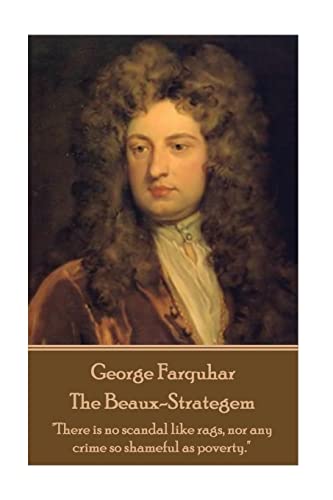
George Farquhar - The Beaux-Strategem by George Farquhar
George Farquhar was born in Derry, Ireland in 1677, one of seven children. Farquhar was educated at Foyle College and later, aged 17, he entered Trinity College, Dublin. He departed after only two years, accounts vary as to why, and he took to acting on the Dublin stage. As an actor he seems to have had no real talent. A terrible accident, when he failed to distinguish between a tipped foil and a deadly rapier, and seriously wounded a fellow actor, resolved Farquhar to give up acting for good. His first play, Love and a Bottle, was well received at London's Drury Lane Theatre in 1699 and was admired for its sprightly Dialogue and busy Scenes. With the play a success Farquhar settled his talents on a career as a playwright. He had a second play open that same year; The Constant Couple. Again, it was warmly received on debuting at Drury Lane and proved a great success. However, another interest and opportunity now unfolded into his life. He received a commission in the regiment of the Earl of Orrery. His time now became divided between the duties of a successful new playwright and the vocations of soldier. In 1701 Farquhar wrote and debuted a sequel to the Constant Couple, called and based on its main character; Sir Harry Wildair. The following year was to be prolific for the young playwright. He penned both The Inconstant or, The Way To Win and The Twin-Rivals as well as publishing Love and Business, a collection that included letters, verse, and A Discourse Upon Comedy. His work for the army, recruiting soldiers to fight in the War of the Spanish Succession, occupied much of his time for the next three years, and he was to write little except The Stage Coach, in 1774. Farquhar was able, however, to draw upon these years of recruiting experience for his next comedy, The Recruiting Officer in 1706. Early in 1707, Farquhar wrote what was to be his masterpiece: The Beaux Stratagem. In these last two plays his real contribution to the English drama is all the more apparent. He introduced a verbal vigour and sparring, as well as a love of character that are more usually associated with Elizabethan dramatists and laid much of the foundations for Sheridan and Congreve to build upon. George Farquhar, aged only 40, died on April 29th, 1707, almost two months after the debut of his greatest work. He was buried in the Church of St. Martin in the Fields, London, on May 3rd, 1707.
Farquhar, George: - George Farquhar (1678-1707) was an Irish-born playwright of the Restoration period. During his ten-year career, he produced two brilliant comedies, The Recruiting Officer in 1706 and The Beaux' Stratagem the following year. The son of a clergyman, he studied at Trinity College, Dublin, before briefly working as an actor at the Smock Alley Theatre in that city. Following an accident during a stage fight, when he mistakenly used a real sword and wounded a fellow actor so badly that he almost died, Farquhar renounced acting. Encouraged by his fellow actor Robert Wilks, he took up the pen and settled in London. His first play Love and a Bottle was well received at Drury Lane in 1698. The following year, The Constant Couple; or, A Trip to the Jubilee was an even greater hit with Wilks in the lead. After Sir Harry Wildair (1701), a sequel to The Constant Couple, and The Twin-Rivals (1702), he wrote his first great play. The first production of The Recruiting Officer starred Anne Oldfield, with whom Farquhar supposedly had an affair. The following year Farquhar, with not one shilling in his pocket, was encouraged by Wilks to produce a hastily written play. The next day Farquhar delivered the plot for The Beaux' Stratagem, which was presented on stage within six weeks. He died from tuberculosis after the third performance.
| SKU | Unavailable |
| ISBN 13 | 9781787373051 |
| ISBN 10 | 1787373053 |
| Title | George Farquhar - The Beaux-Strategem |
| Author | George Farquhar |
| Condition | Unavailable |
| Binding Type | Paperback |
| Publisher | Stage Door |
| Year published | 2017-06-01 |
| Number of pages | 114 |
| Cover note | Book picture is for illustrative purposes only, actual binding, cover or edition may vary. |
| Note | Unavailable |