


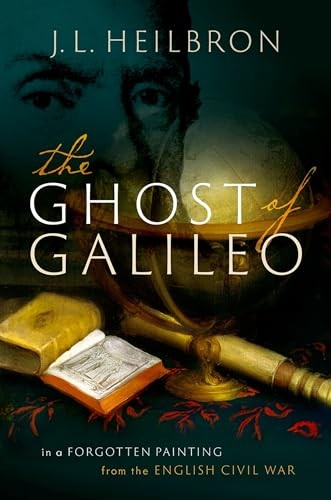
The Ghost of Galileo by Jl Heilbron
In 1643/4 the once-famous Francis Cleyn painted the unhappy young heir of Corfe Castle, John Bankes, and his tutor, Dr Maurice Williams. The painter is now almost forgotten,the painting much neglected, and the sitters themselves have left little to mark their lives, but on the table of the painting lies a book, open to an immediately identifiable and very significant page. The representation omits the author's name and the book's title; it sits there as a code, as only viewers who had encountered the original and the characteristic figures on its frontispiece would have known its significance. The book is Galileo's Dialogue on the two chief world systems (1632), the defence of Copernican cosmology that incited the infamous clash between its author and the Church, and its presence in this painting is no accident, but instead a statement of learning, attitudes, and cosmopolitan engagement in European discourse by the painting's English subjects. Grasping hold of the clue, John Helibron deciphers the significance of this contentious book's appearance in a painting from Stuart England to unravel the interlocking threads of art history, political and religious history, and the history of science. Drawing on unexploited archival material and a wide range of printed works, he weaves together English court culture and Italian connections, as well as the astronomical and astrological knowledge propagated in contemporary almanacs and deployed in art, architecture, plays, masques, and political discourse. Heilbron also explores the biographies of Sir John Bankes (father of the sitter), Sir Maurice, and the painter, Francis Cleyn, setting them into the narrative of their rich and cultured history.
The Ghost of Galileo is.. a work of serious scholarship... it is brilliant, and unlike anything I expect to read all year. * Tim Smith-Laing, Daily Telegraph *
... insightful and unusual... A massive amount of information is conveyed in a lively style, with a nice line in deadpan humour... a generous and original book. * Joe Moshenska, Times Literary Supplement *
If ever a book has defied summary, this is it. Mr. Heilbron takes his readers on an exhilarating, 500-page ride through the first half of the 17th century, beginning with the tangled web of political and intellectual relations between the English and the Italians, specifically the quarrel between worldly, pleasure-loving Venice and authoritarian, stuck-up Rome... * Christoph Irmscher, Wall Street Journal *
Beginning with the painting itself and following a number of threads in weaving together - in a way that truly shows the humanities at their best - the history of science, art history, the history of religion, and political history of the early modern period, Prof. Heilbron explores the social, religious, artistic, and scientific landscapes of that time. * The Well-Bred Naturalist *
This is a strikingly unusual book. In 2010, the year in which the author's definitive biography of Galileo and his work was published, the author chanced upon an unusual double portrait by a now unjustly little-known artist, in the dark upper corridor of a house in Dorset belonging to the National Trust ... It is a puzzle without a definitive solution, but the search for one is utterly absorbing. * Alastair Laing, Art Historian, former Curator of Pictures and Sculpture, National Trust *
This splendid study reanimates a portrait of an English scholar and his student, taking as its focal point a copy of Galileo's recent Dialogue concerning the Two Chief World Systems. The relationship of this curious foreground detail to the big picture will captivate historians of early modern science, art, literature, politics, and religion. * Professor Eileen Reeves, author of Galileo's Glassworks: The Telescope and the Mirror *
... insightful and unusual... A massive amount of information is conveyed in a lively style, with a nice line in deadpan humour... a generous and original book. * Joe Moshenska, Times Literary Supplement *
If ever a book has defied summary, this is it. Mr. Heilbron takes his readers on an exhilarating, 500-page ride through the first half of the 17th century, beginning with the tangled web of political and intellectual relations between the English and the Italians, specifically the quarrel between worldly, pleasure-loving Venice and authoritarian, stuck-up Rome... * Christoph Irmscher, Wall Street Journal *
Beginning with the painting itself and following a number of threads in weaving together - in a way that truly shows the humanities at their best - the history of science, art history, the history of religion, and political history of the early modern period, Prof. Heilbron explores the social, religious, artistic, and scientific landscapes of that time. * The Well-Bred Naturalist *
This is a strikingly unusual book. In 2010, the year in which the author's definitive biography of Galileo and his work was published, the author chanced upon an unusual double portrait by a now unjustly little-known artist, in the dark upper corridor of a house in Dorset belonging to the National Trust ... It is a puzzle without a definitive solution, but the search for one is utterly absorbing. * Alastair Laing, Art Historian, former Curator of Pictures and Sculpture, National Trust *
This splendid study reanimates a portrait of an English scholar and his student, taking as its focal point a copy of Galileo's recent Dialogue concerning the Two Chief World Systems. The relationship of this curious foreground detail to the big picture will captivate historians of early modern science, art, literature, politics, and religion. * Professor Eileen Reeves, author of Galileo's Glassworks: The Telescope and the Mirror *
John Heilbron is Professor of History and the Vice Chancellor Emeritus at the University of California, Berkeley, as well as an Honorary Fellow of Worcester College, Oxford. He writes about the history of the physical sciences and their wider cultural context from the 17th to the 20th centuries, and has published the definitive biography of Galileo (OUP, 2010), as well as The History of Physics: A Very Short Introduction (OUP, 2018), and Niels Bohr: A Very Short Introduction, (OUP, 2020) . Heilbron's work has won several prizes and brought him honorary doctorates from multiple universities.
| SKU | Unavailable |
| ISBN 13 | 9780198861300 |
| ISBN 10 | 0198861303 |
| Title | The Ghost of Galileo |
| Author | Jl Heilbron |
| Condition | Unavailable |
| Binding Type | Hardback |
| Publisher | Oxford University Press |
| Year published | 2021-01-28 |
| Number of pages | 528 |
| Cover note | Book picture is for illustrative purposes only, actual binding, cover or edition may vary. |
| Note | Unavailable |