


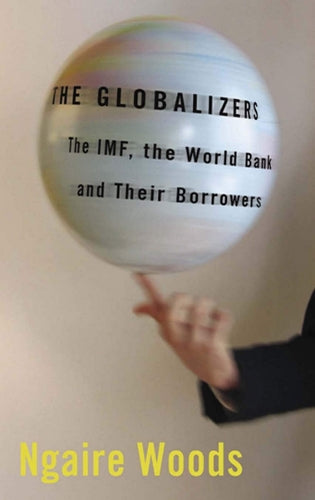
The Globalizers by Ngaire Woods
The IMF and the World Bank have integrated a large number of countries into the world economy by requiring governments to open up to global trade, investment, and capital. They have not done this out of pure economic zeal. Politics and their own rules and habits explain much of why they have presented globalization as a solution to challenges they have faced in the world economy.—from the Introduction The greatest success of the International Monetary Fund and the World Bank has been as globalizers. But at whose cost? Would borrowing countries be better off without the IMF and World Bank? This book takes readers inside these institutions and the governments they work with. Ngaire Woods brilliantly decodes what they do and why they do it, using original research, extensive interviews carried out across many countries and institutions, and scholarship from the fields of economics, law, and politics. The Globalizers focuses on both the political context of IMF and World Bank actions and their impact on the countries in which they intervene. After describing the important debates between U.S. planners and the Allies in the 1944 foundation at Bretton Woods, she analyzes understandings of their missions over the last quarter century. She traces the impact of the Bank and the Fund in the recent economic history of Mexico, of post-Soviet Russia, and in the independent states of Africa. Woods concludes by proposing a range of reforms that would make the World Bank and the IMF more effective, equitable, and just.After World War II, the winning powers created the IMF, to bring stability to the international monetary system, and the World Bank, to channel investment into development and reconstruction projectsWoods examines both institutions and how they have preformed these roles in regard to underdeveloped borrower nations. She chronicles the involvement of the IMF and the World Bank with Mexico, Russia, and sub-Saharan Africa. In a very balanced analysis, she shows that both institutions have failed in many instances to improve the lot of such countries, too often promoting policies to please their powerful shareholder nations such as the United States while failing to understand and deal with the special needs of borrower nations. She concludes by recommending six reforms for the two institutions to make them more open and equitable in their advertising and lending.
* Library Journal *Perhaps mirroring public debate on the issue, scholarship on the role of the IMF and the World Bank in economic development has often treated these institutions as mere conduits of U.S. interest. In The Globalizers, Ngaire Woods seeks to amend this perception, offering a rich account of their activities that emphasizes the inner workings of these institutions and their negotiations with policymakers in developing countries. As such, The Globalizers provides an invaluable look at the processes that shape the IMF and World Bank's role in the global economy.
* International Studies Review *Ngaire Woods is a Tenured Fellow at University College, Oxford, and Director of the Global Economic Governance Programme at Oxford University. She is the editor of The Political Economy of Globalization and Explaining International Relations since 1945 and the coeditor of Inequality, Globalization, and World Politics.
| SKU | Unavailable |
| ISBN 13 | 9780801444241 |
| ISBN 10 | 0801444241 |
| Title | The Globalizers |
| Author | Ngaire Woods |
| Series | Cornell Studies In Money |
| Condition | Unavailable |
| Publisher | Cornell University Press |
| Year published | 2006-03-29 |
| Number of pages | 272 |
| Prizes | Winner of A 2006 Choice Magazine "Outstanding Academic Title. |
| Cover note | Book picture is for illustrative purposes only, actual binding, cover or edition may vary. |
| Note | Unavailable |